Week 10 Focus

Week 10 moves from the decision to invest abroad to the larger management challenge that follows: How should an international firm compete, organize, allocate resources, and respond across different markets? International strategic management connects competitive advantage to the choices a firm makes at the corporate, business, and functional levels.

75 min in person~75 min asynchronousCompetitive advantage + strategy levels

Weekly Design

In-Person Session

75 minutes • Introduction + instructor-led application

1. What Is International Strategic Management?

International strategic management is the ongoing process of formulating and implementing strategies that allow a firm to compete effectively across national markets. The challenge is broader than choosing a country: managers must decide where to compete, how to compete, what capabilities create advantage, and how different parts of the organization should work together.

Corporate Strategy — Predict the Outcome

Begin with a live class poll exploring three corporate-level approaches: single business, related diversification, and unrelated diversification. Across three five-year scenarios, predict which firm produced the largest percentage change in revenue, then compare the class prediction with the source-provided result.

This is an exploratory poll rather than a scored activity. Use the reveal to discuss why no corporate strategy automatically guarantees stronger performance.

Three Sources of Competitive Advantage

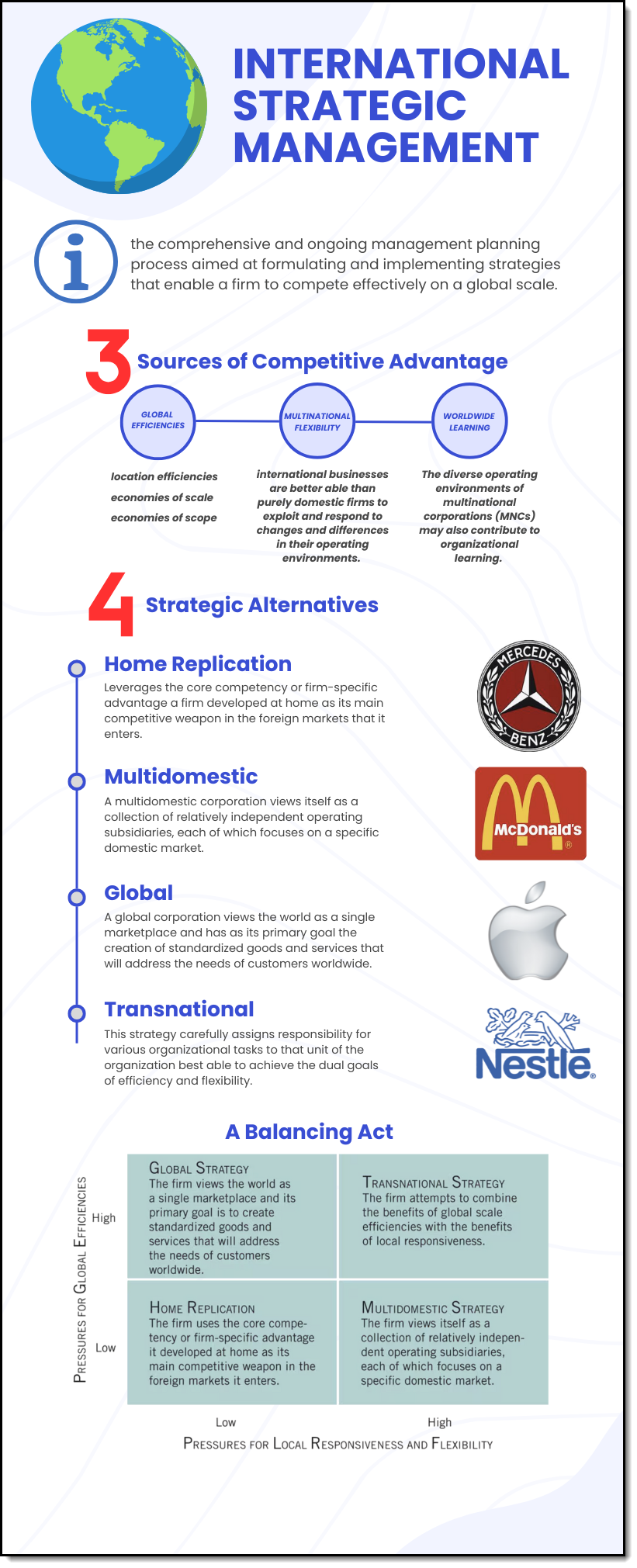
Global efficiencies can come from location choices, scale, and scope. Multinational flexibility helps firms respond to differences among national environments. Worldwide learning allows knowledge from one market to improve performance elsewhere.

2. Four International Strategic Alternatives

Firms can emphasize a domestically developed advantage through home replication, adapt heavily through a multidomestic strategy, standardize globally through a global strategy, or attempt to combine worldwide efficiency with local responsiveness through a transnational strategy.

The balancing act

The four alternatives become easier to distinguish when you ask two questions: How strong are the pressures for global efficiencies? How strong are the pressures for local responsiveness and flexibility?
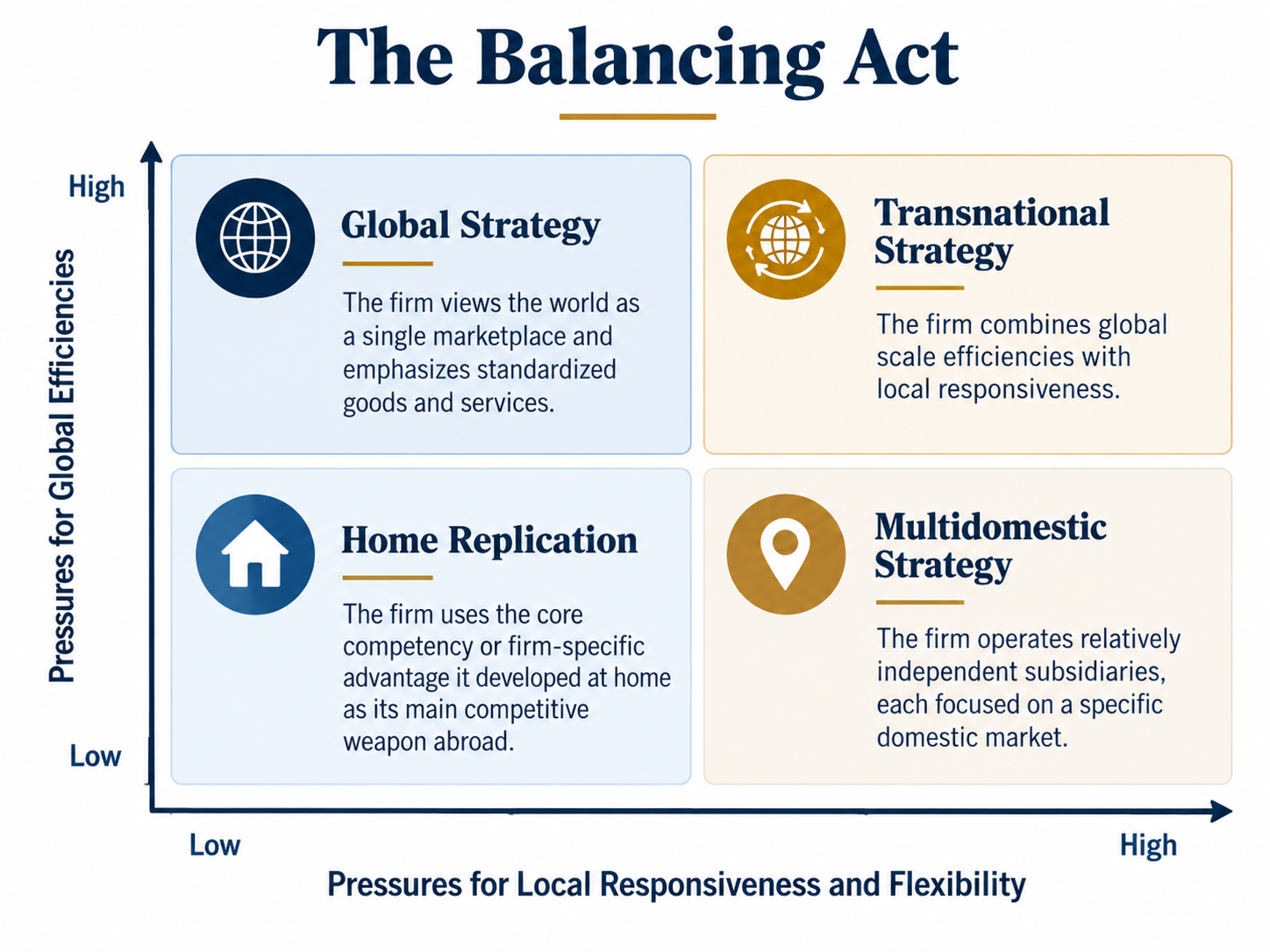
The Balancing Act matrix showing Home Replication, Multidomestic, Global, and Transnational strategies by pressures for global efficiencies and local responsiveness

3. Strategy Review — Team Challenge

Work in one of six teams to apply the week’s core strategy concepts. The activity begins with the three sources of competitive advantage and then moves to the four international strategic alternatives. Discuss each scenario with your team and lock in one answer before the instructor reveals the result.

How the team challenge works

Each team uses one device. Answers are locked once submitted and remain hidden from the other teams until the instructor reveals the correct response. The scoreboard updates throughout the activity, and each reveal includes a short explanation so you can distinguish closely related concepts such as multidomestic and transnational strategy.
Asynchronous Session

Approximately 60–75 minutes • Strategy Console

Strategy Console

Work individually through a series of strategic signals. For each scenario, first identify the correct level of strategy—corporate, business, or functional—then select the specific strategy or business function that best fits.

Two-tier decision process

Tier 1: determine whether the decision belongs to corporate, business, or functional strategy. Tier 2: use the menu that opens within that level to identify the specific strategy or function. You may change your Tier 1 selection until you commit to a Tier 2 answer.

What to watch for

Ask what kind of decision the scenario describes before looking for a familiar term. Corporate strategy defines the firm’s business domain, business strategy addresses how a business competes, and functional strategy aligns areas such as finance, marketing, operations, HR, and R&D.

Resources

Begin with the video. Hover over an infographic to enlarge it; click an infographic to open its full PDF.

International Strategic Management

Use this video as the starting point for the week’s major ideas: competitive advantage, international strategic alternatives, and the levels of strategy.

International Strategic Management

Competitive advantage, home replication, multidomestic, global, and transnational strategies.

International Strategic Management infographic

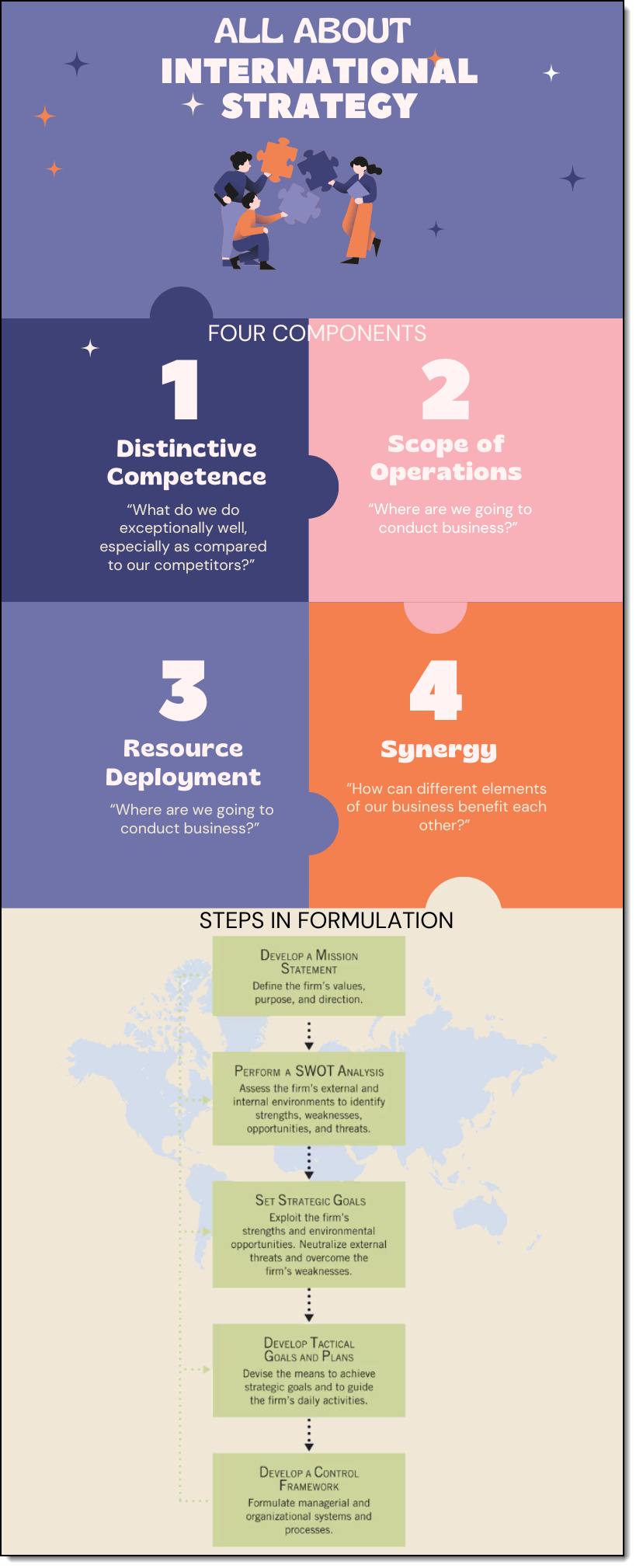
International Strategy: Four Components

Distinctive competence, scope of operations, resource deployment, synergy, and the strategy-formulation process.

International Strategy components infographic

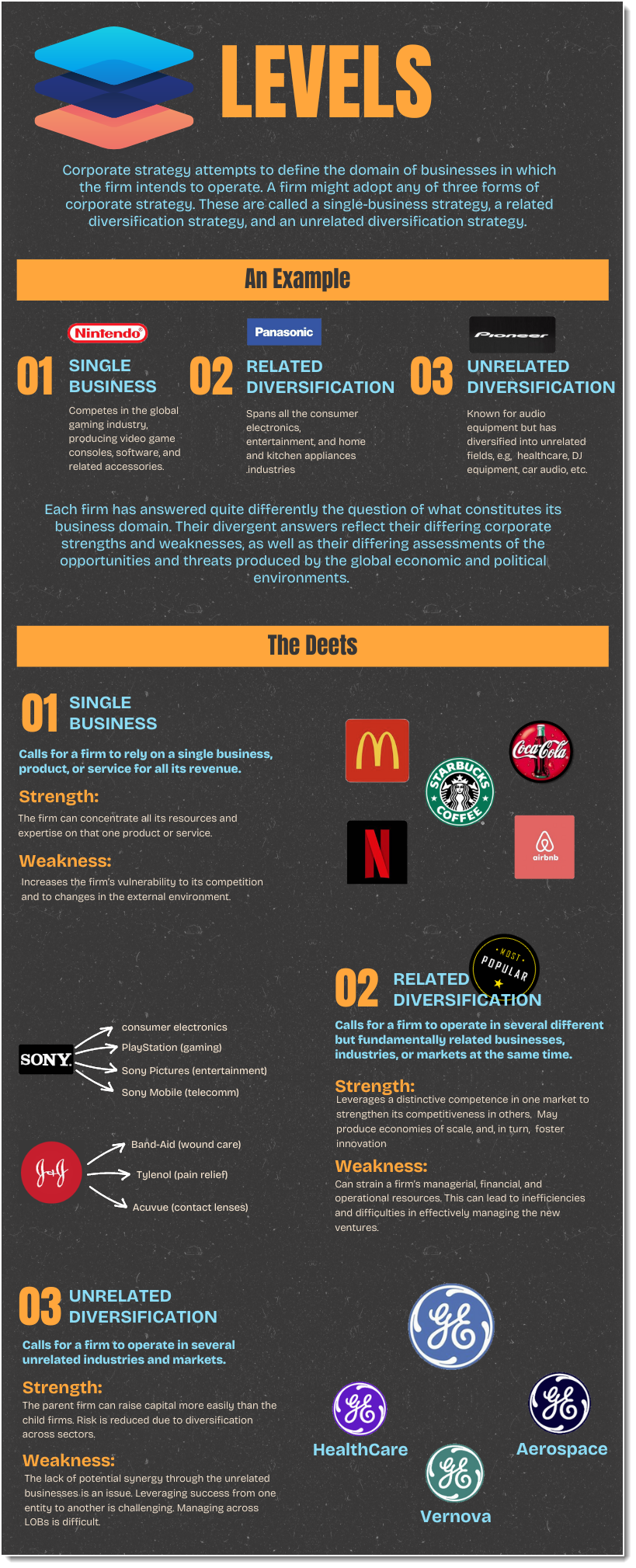
Corporate Strategy Levels

Single-business, related diversification, and unrelated diversification as corporate-level choices.

Corporate strategy levels infographic

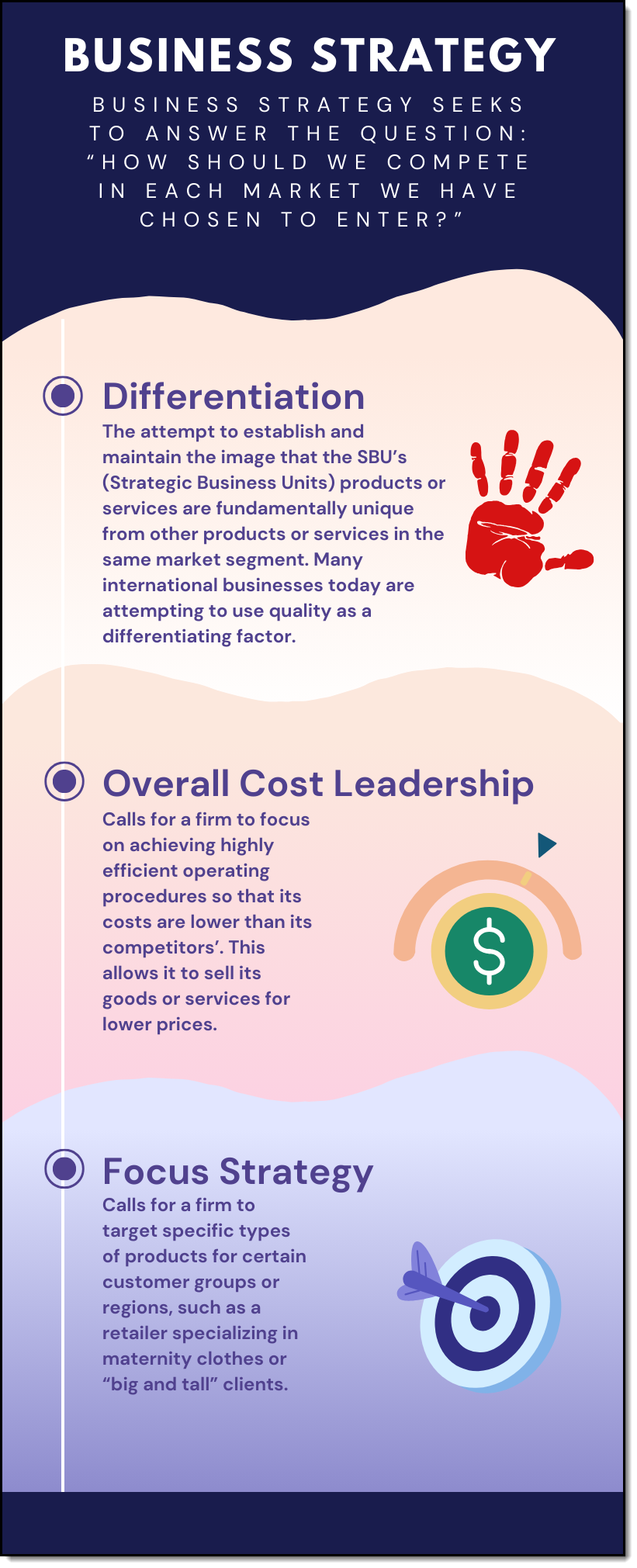
Business Strategy

Differentiation, overall cost leadership, and focus as approaches to competing within a chosen market.

Business strategy infographic

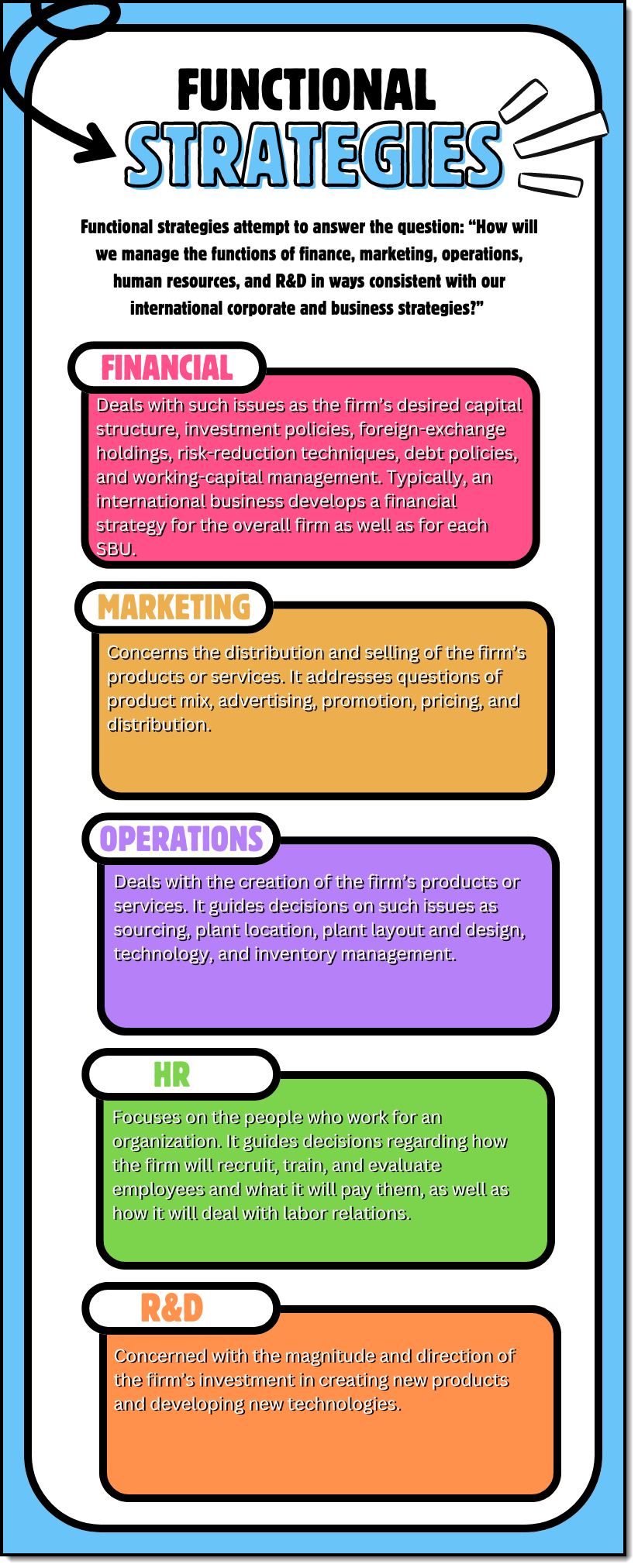
Functional Strategies

How finance, marketing, operations, human resources, and R&D support corporate and business strategy.

Functional strategies infographic
International Strategic Management podcast thumbnail

Deep Dive: International Strategic Management

Use the podcast as another way to review the week’s major concepts and the connections among competitive advantage, international strategy, and organizational levels.

Listen to the Deep Dive

Week 10 Glossary

These terms support the week’s work on international strategic management, strategic alternatives, formulation and implementation, and the corporate, business, and functional levels of strategy.

International Strategic Management

A comprehensive and ongoing management planning process aimed at formulating and implementing strategies that enable a firm to compete effectively internationally.

Strategic Planning

The process of developing a particular international strategy, typically the responsibility of top-level executives and senior managers.

Home Replication Strategy

A strategic alternative where a firm utilizes its domestically developed core competency or firm-specific advantage as its main weapon in foreign markets.

Multidomestic Strategy

A strategic alternative where a firm views itself as a collection of relatively independent operating subsidiaries, each focusing on a specific domestic market.

Global Strategy

A strategic alternative where a firm views the world as a single marketplace and aims to create standardized goods and services to meet worldwide customer needs.

Transnational Strategy

A strategic alternative where a firm attempts to combine the benefits of global scale efficiencies with the benefits of local responsiveness.

Distinctive Competence

What a firm does exceptionally well, especially compared to its competitors, forming the basis for a sustainable competitive advantage.

Sustainable Competitive Advantage

An advantage over a firm's competitors that can be maintained over time.

Scope of Operations

The geographic regions, markets, or product niches in which a firm conducts business.

Resource Deployment

How a firm allocates its resources across the markets in which it competes, potentially along product lines, geographical lines, or both.

Synergy

How different elements of a firm's business can benefit each other.

Strategy Formulation

The stage of international strategic management where a firm establishes its goals and the strategic plan to achieve them.

Strategy Implementation

The stage of international strategic management where a firm develops the processes and tactics to achieve the formulated international strategies.

Mission Statement

A statement that attempts to clarify an organization’s values, purposes, and directions.

Environmental Scanning

The systematic collection of data about all elements of the firm’s internal and external environments.

SWOT Analysis

An assessment of a firm's internal strengths and weaknesses and external opportunities and threats.

Value Chain

A framework that breaks down a firm into its important activities to identify competitive strengths and weaknesses.

Strategic Goals

The major objectives a firm wants to accomplish through pursuing a particular course of action; should be measurable, feasible, and time-limited.

Tactics

Specific tactical goals and plans, often involving middle managers, focused on the details of how to implement strategic plans.

Control Framework

The managerial and organizational process used to keep the firm on target toward its strategic goals.

Corporate Strategy

The level of strategy that helps a firm define the domain of business in which it intends to operate, including single-business, related diversification, and unrelated diversification.

Single-Business Strategy

A corporate strategy where a firm relies on a single business, product, or service for all its revenue.

Related Diversification

A corporate strategy where a firm operates in several different, but related businesses, industries, or markets at the same time.

Unrelated Diversification

A corporate strategy where a firm operates in several unrelated industries and markets.

Conglomerate

A firm comprised of unrelated businesses, often resulting from an unrelated diversification strategy.

Business Strategy

The level of strategy that focuses on each line of business within an organization, addressing how to compete in each chosen market; includes differentiation, overall cost leadership, and focus.

Strategic Business Unit (SBU)

A grouping of related business lines within a diversified firm.

Differentiation

A business strategy where a firm attempts to establish and maintain the image that its products or services are fundamentally unique from others in the same market segment.

Overall Cost Leadership

A business strategy where a firm focuses on achieving highly efficient operating procedures so that its costs are lower than its competitors', allowing it to sell products in high volumes at low prices.

Focus Strategy

A business strategy where a firm targets specific types of products for certain customer groups or regions, matching product features to specific consumer needs.

Functional Strategy

The level of strategy that addresses how to manage the functions of finance, marketing, operations, human resources, and research and development in ways consistent with international corporate and business strategies.

Week 10 Knowledge Check

International Strategic Management

Complete a randomized 10-question knowledge check built primarily from the Week 10 glossary. The check emphasizes recognition of the week’s major terms, strategic alternatives, components of international strategy, and the corporate, business, and functional levels of strategy.

Answer choices appear one at a time and continue cycling until you select a response. Complete the knowledge check after finishing the Week 10 activities and reviewing the resources and glossary above.

Looking ahead: Week 11 continues the strategy sequence by moving from the structure of international strategy to its application.