Week 9 Focus

Week 9 shifts from what firms and countries trade to how capital itself crosses borders. We distinguish portfolio investment from foreign direct investment, then use investment theory to ask a more demanding question: why would a firm own and control operations abroad rather than simply export, license, or invest passively?

75 min in person~75 min asynchronousFDI + class map + OLI

Weekly Design

In-Person Session

75 minutes • Trade simulation + collective FDI map

1. Let’s Make a Deal — Round 2

Return to your assigned country for the second round of the live trade simulation. Negotiate under the new tariff environment, weigh the value of each trade against its strategic effect, and track how the round changes your country’s GDP position.

Round 2 Focus

Tariffs now change the economics of the same trade relationships you evaluated in Round 1. The goal is not simply to trade more—it is to make deals that improve your national position under the new policy constraints.

2. FDI Map: Follow the Capital

Work individually to find and document three major examples of foreign direct investment. For each example, place a pin on the destination country and record the investment value, the company acquired or investment target, the foreign acquirer, the sector, and a brief evaluation of why the investment matters.

Build the class map

The same country may appear more than once. Each saved record becomes a pin on the collective map, allowing the class to see where FDI clusters and which sectors attract the most cross-border investment.

  1. 0–40 min: Let’s Make a Deal — Round 2 negotiation and close.
  2. 40–50 min: Round 2 results and tariff debrief.
  3. 50–75 min: Complete three FDI pins and explore the collective class map.
Asynchronous Session

Approximately 60–75 minutes • Venturea OLI investment decision

The OLI Investment Decision

Venturea is preparing a major foreign expansion. Use Dunning’s Eclectic (OLI) framework to determine which of four proposed investments provides the strongest strategic logic for foreign direct investment. Your task is not simply to find the biggest market or the lowest cost—you must explain why Venturea should own and control the activity in that location.

OOwnershipDoes Venturea possess firm-specific assets or capabilities strong enough to overcome the disadvantages of operating abroad?
LLocationIs there an advantage to performing the activity in this country rather than at home or in another market?
IInternalizationDoes Venturea gain more by controlling the activity itself than by licensing, contracting, franchising, or relying on an outside partner?

Four proposals • One recommendation

Compare the investment cases in Zandora, Noveria, Eryndor, and Brayland. Each proposal includes attractive features and meaningful tradeoffs involving cost, timing, ownership, intellectual property, infrastructure, workforce, and political exposure.

ZandoraNoveriaEryndorBrayland
  1. Review Venturea. Identify the firm-specific technologies, capabilities, and constraints that create—or limit—an ownership advantage.
  2. Compare all four projects. Use the country and project evidence to judge the location advantage of each proposal.
  3. Test internalization. Ask whether Venturea should own the activity or could capture most of the benefit through licensing, contracting, or a partner.
  4. Make one recommendation. Select the project with the strongest overall FDI logic, address at least one important tradeoff, and compare it with a competing proposal.
  5. Prepare the written recommendation. Follow the assignment guidance in the OLI packet for the 2–3 page APA submission.

Keep the central question in view: Why should Venturea own this activity in this particular foreign market rather than serve the market from the United States or hand the activity to another firm?

Resources

Begin with the video. Hover over an infographic to enlarge it; click to open the full image or PDF.

International Investment

A short overview of international investment, FDI, FPI, and the logic behind cross-border capital flows.

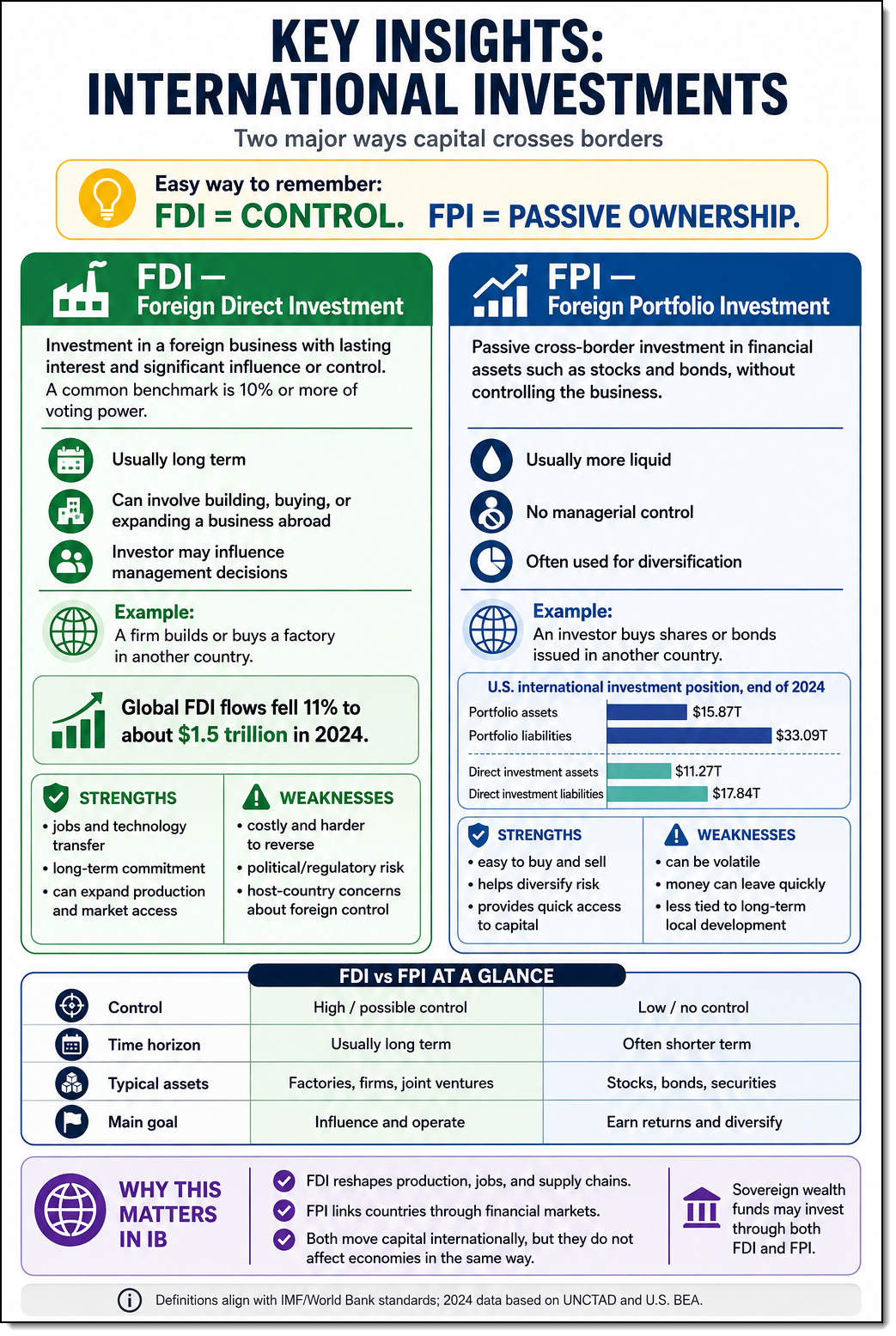
International Investments: FDI & FPI

Use this comparison to separate investment that carries influence or control from passive ownership of foreign financial assets.

Key Insights International Investments infographic comparing FDI and FPI

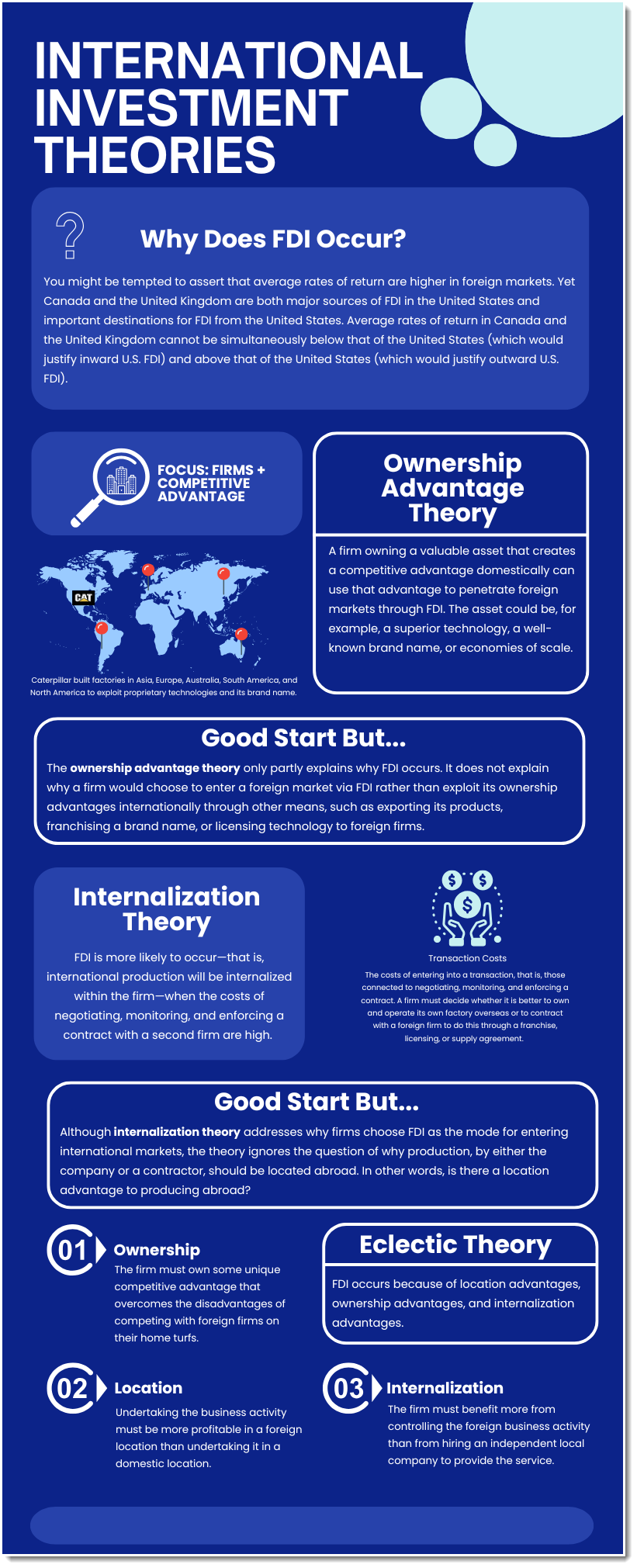
International Investment Theories

Review ownership advantage, internalization, and the eclectic OLI framework for explaining why FDI occurs.

International Investment Theories infographic

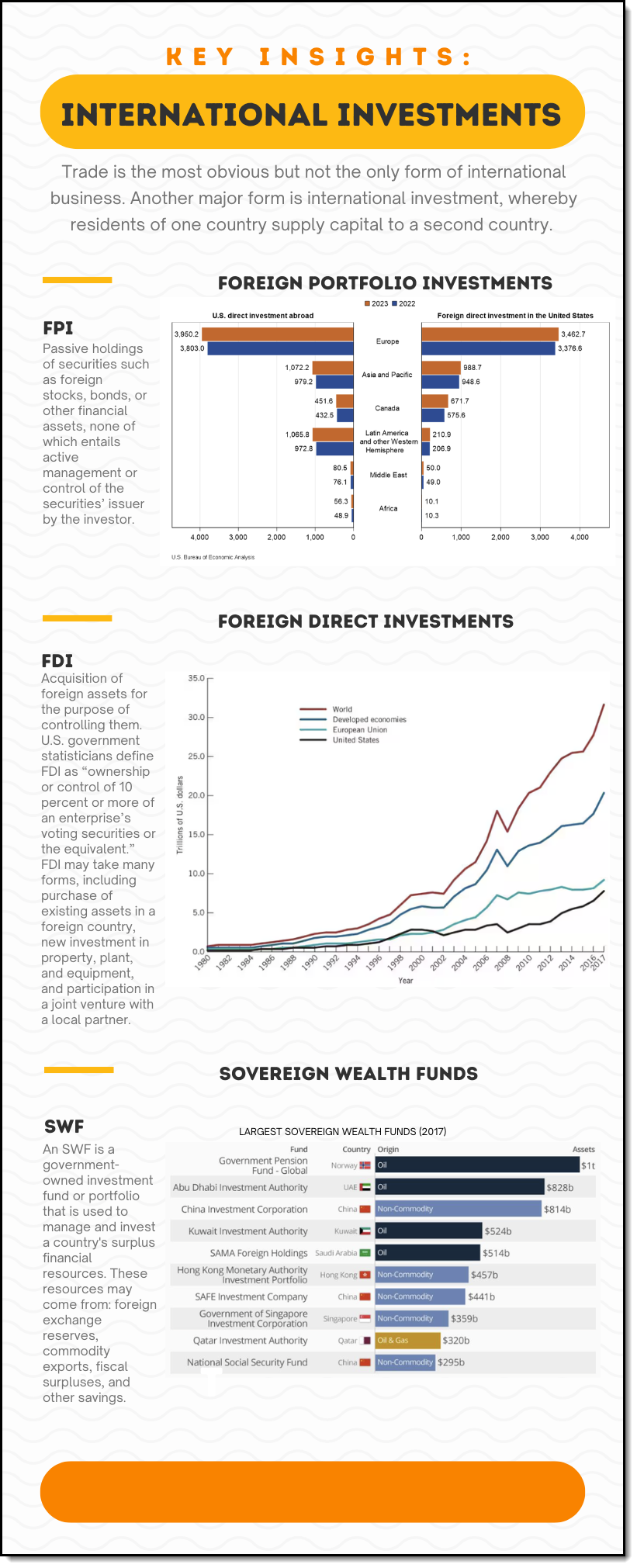
International Investment Detail

A second reference view of FPI, FDI, and sovereign wealth funds for deeper review.

Detailed Key Insights International Investments infographic
Deep Dive International Trade and FDI podcast thumbnail

Deep Dive: International Trade & FDI

Use the podcast as another way to review how trade and foreign direct investment differ, why firms choose ownership and control abroad, and how the OLI framework helps explain international investment decisions.

Listen to the Deep Dive

Week 9 Glossary

These terms are tailored to this week’s focus on international investment, FDI versus FPI, and the OLI decision framework.

International Investment

The movement of capital across national borders in order to own financial assets or acquire a lasting interest in foreign business activity.

Foreign Portfolio Investment (FPI)

Passive ownership of foreign financial assets such as stocks or bonds without managerial control of the underlying business.

Foreign Direct Investment (FDI)

Cross-border investment that creates a lasting interest and meaningful influence or control over a foreign business operation.

Greenfield Investment

FDI in which a firm builds a new facility or operation in a foreign country rather than purchasing an existing business.

Acquisition

FDI in which a firm purchases an existing foreign company or significant foreign business assets.

Home Country

The country in which the investing firm is based.

Host Country

The foreign country receiving the investment.

Ownership Advantage

A firm-specific asset or capability—such as proprietary technology, brand strength, know-how, or managerial expertise—that helps the firm compete abroad.

Location Advantage

A benefit tied to performing a business activity in a particular foreign market rather than in the home country or another location.

Internalization Advantage

The benefit a firm receives by controlling an activity itself rather than licensing, outsourcing, franchising, or contracting it to another organization.

OLI Framework

Dunning’s Eclectic framework, which proposes that FDI is most compelling when Ownership, Location, and Internalization advantages are all present.

Transaction Costs

The costs of negotiating, monitoring, coordinating, and enforcing exchanges or contracts with outside firms.

Control

The ability of the investing firm to influence or direct decisions, assets, operations, technology, or management in the foreign activity.

Sovereign Wealth Fund

A government-owned investment fund that invests national financial assets, often across international markets.

Political Exposure

The possibility that government actions, instability, policy changes, or regulation will affect the value or operation of a foreign investment.

Tariff

A tax imposed on imported goods that can change the economics of cross-border trade and influence investment decisions.

Week 9 Knowledge Check

Dunning’s Eclectic Theory (OLI)

Complete a randomized 10-question knowledge check focused on applying Dunning’s Ownership–Location–Internalization framework. Rather than simply recalling definitions, you will analyze short international investment scenarios, identify which OLI element is strongest or weakest, and determine when the three advantages work together to support foreign direct investment.

Each attempt draws 10 questions from a larger pool and includes a balanced mix of foundation, application, and integration questions. Answer choices appear one at a time and continue cycling until you make a selection. Each question is worth 1 point. A score of 7/10 or higher completes the check; a lower score allows a new randomized attempt.

Looking ahead: Week 10 moves from investment decisions to international strategic management—how firms organize choices across markets, capabilities, and competitive pressures.