Week 3 Focus

Week 3 Focus

A market can look attractive on paper and still create serious problems for an international business. Laws differ. Governments intervene. Technology moves across borders. Intellectual property can be difficult to protect. Political disputes can alter shipping routes, sourcing, insurance, investment, and customer access. This week focuses on learning to scan the environment, identify what matters most, and translate external conditions into business implications.

Big question: When several PESTLE forces are present at the same time, which one should a manager treat as primary—and what should the firm do about it?
75 min • in person~75 min • asynchronousEnvironmental scanningPESTLE + managerial judgment

Tiny Island, Big Trouble: The Ripple Effect

In Person • Trace a geopolitical flashpoint into business consequences

A small maritime confrontation can create consequences far beyond the location where it occurs. In this short, team-based interaction, you will investigate a South China Sea flashpoint and follow the chain from an event to wider international-business effects.

Interaction flow

  1. BriefStart with the Scarborough Shoal confrontation and identify why a seemingly remote dispute could matter to international firms.
  2. ResearchWork from one research desk—law, the flashpoint, the Spratly Islands, the regional map, or global-business effects—and verify what is happening.
  3. RippleBuild a chain from pebble → ripple → wave → impact, connecting the event to effects such as shipping, insurance, seafood sourcing, energy exploration, investment, or landed costs.
  4. ReportDeliver a concise rapid report explaining the event, the ripple effect, and why an international manager should care.
Managerial lens: do not stop at describing the political event. The goal is to explain the business consequence and identify who bears the risk, cost, delay, or strategic constraint.
USMCA 2026: What Does the Data Suggest?

Asynchronous • Individual trade-data audit

The United States, Canada, and Mexico entered the first required USMCA review in summer 2026. The United States did not agree to renew the agreement in its current form and pointed, in part, to trade deficits and concerns about how the agreement was operating.

Your task is to investigate the argument rather than simply accept either side. Using World Bank, IMF, and official policy sources, compare how the three economies have performed and examine U.S. bilateral trade with Canada and Mexico.

Your workflow

  1. ReviewRevisit the USMCA and understand what happened during the 2026 review.
  2. CollectCompare 2019 with the latest available country-level indicators for the United States, Canada, and Mexico.
  3. AuditExamine U.S.–Canada and U.S.–Mexico bilateral trade before USMCA and in the latest complete pre-review year.
  4. JudgeDetermine which country appears to have fared better and how strongly the evidence supports the U.S. position.
  5. SubmitDownload the Word-readable audit report and upload it to the Week 3 Brightspace assignment.
Evidence rule: a trade deficit is an observation, not automatically proof that a trade agreement is fair or unfair. Your conclusion must distinguish what the data show from what they cannot establish on their own.
How the pieces connect

From external event to managerial response

Tiny Island, Big Trouble demonstrates that an event far from a company’s headquarters can move through a chain of political, legal, logistical, and financial consequences. The asynchronous USMCA Audit applies that thinking to trade policy: examine economic and bilateral trade evidence, assess the argument behind a policy decision, and distinguish what the data show from what they cannot establish.

Week 3 Resources

Watch first, then use the visuals as references.

The three Chapter 3 videos now appear at the top of the resource section. Use them first, then review the infographics and podcast below.

Law, Technology, and Politics

Global Innovation: Tech Transfer

Global Business Environments: Tech & Politics

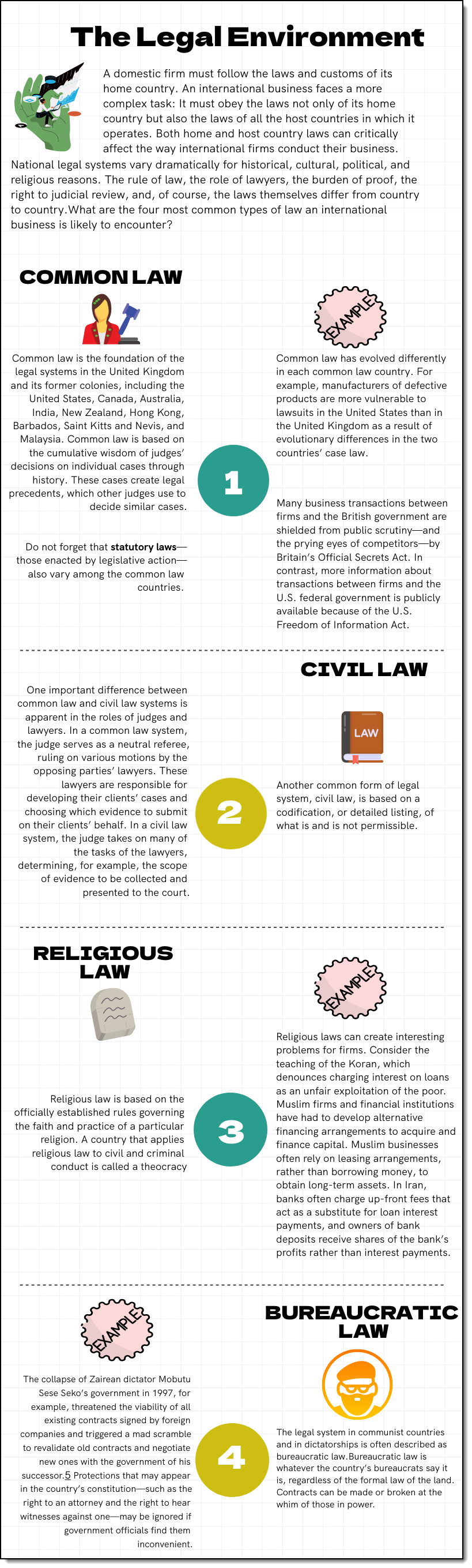
4 Types of Law

Compare major legal traditions and how they shape contracts, enforcement, ownership, and business risk.

4 Types of Law infographic

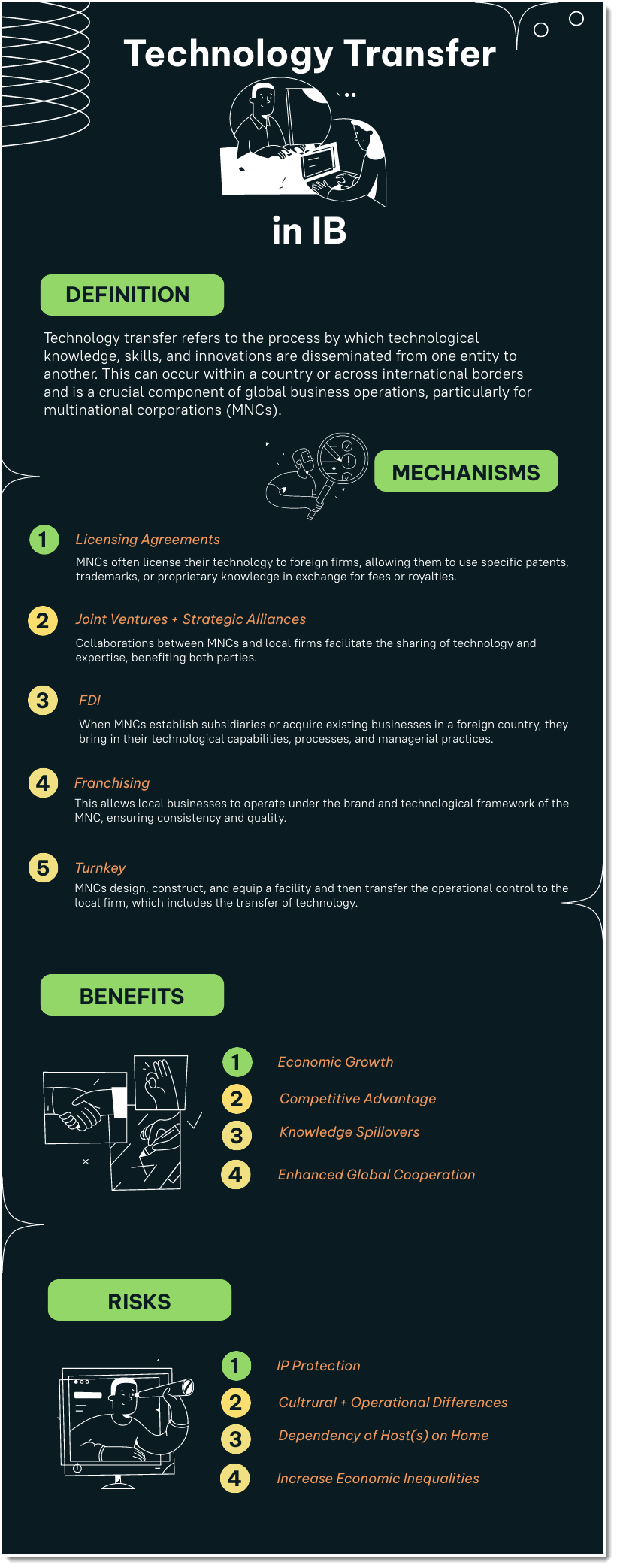
Technology Transfer in IB

Review how technology and know-how cross borders, why firms transfer them, and what strategic or legal risks may follow.

Technology Transfer in International Business infographic

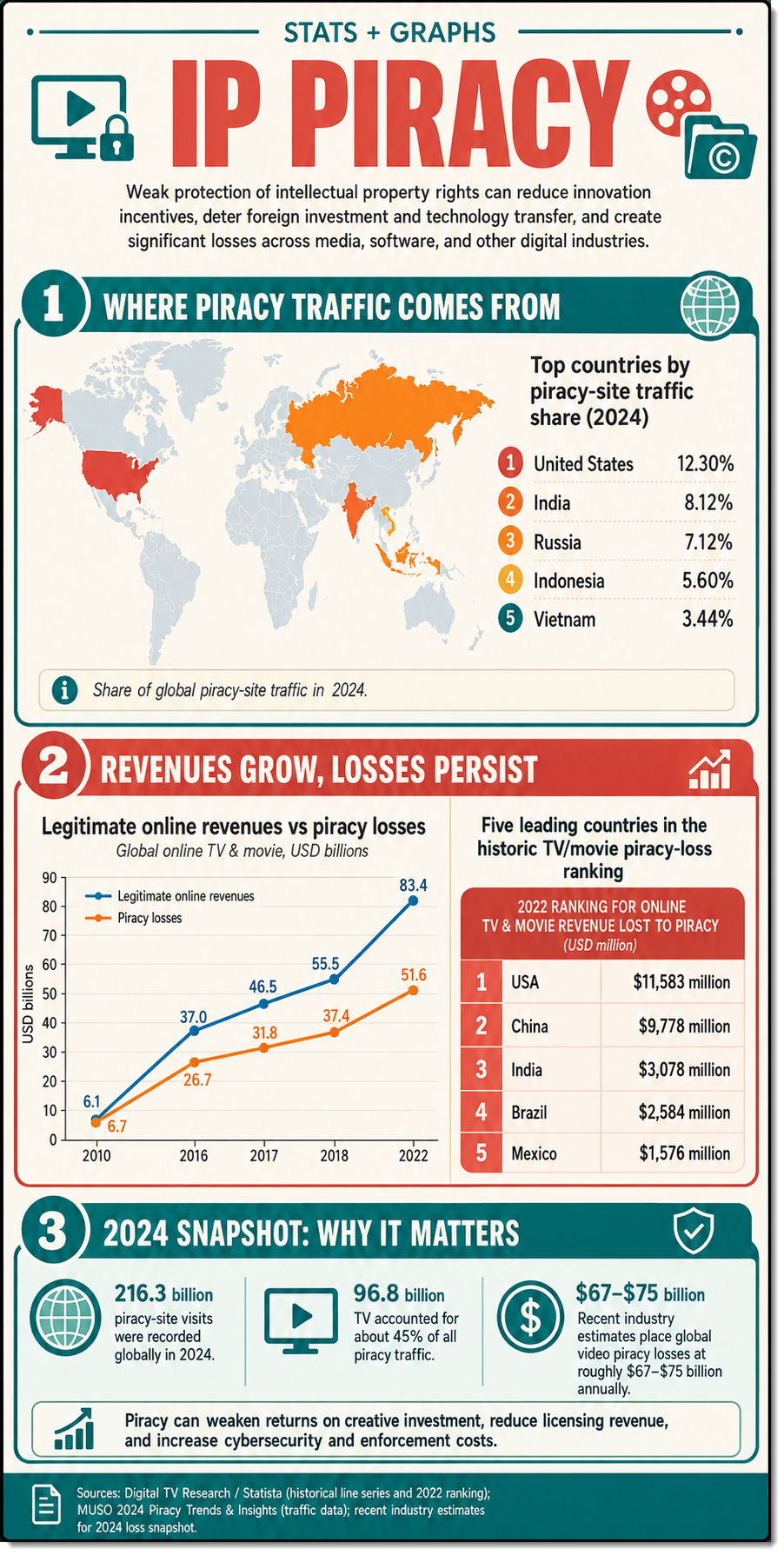
IP Piracy

Examine the business consequences of intellectual-property piracy and the relationship among protection, innovation, investment, and revenue loss.

IP Piracy infographic

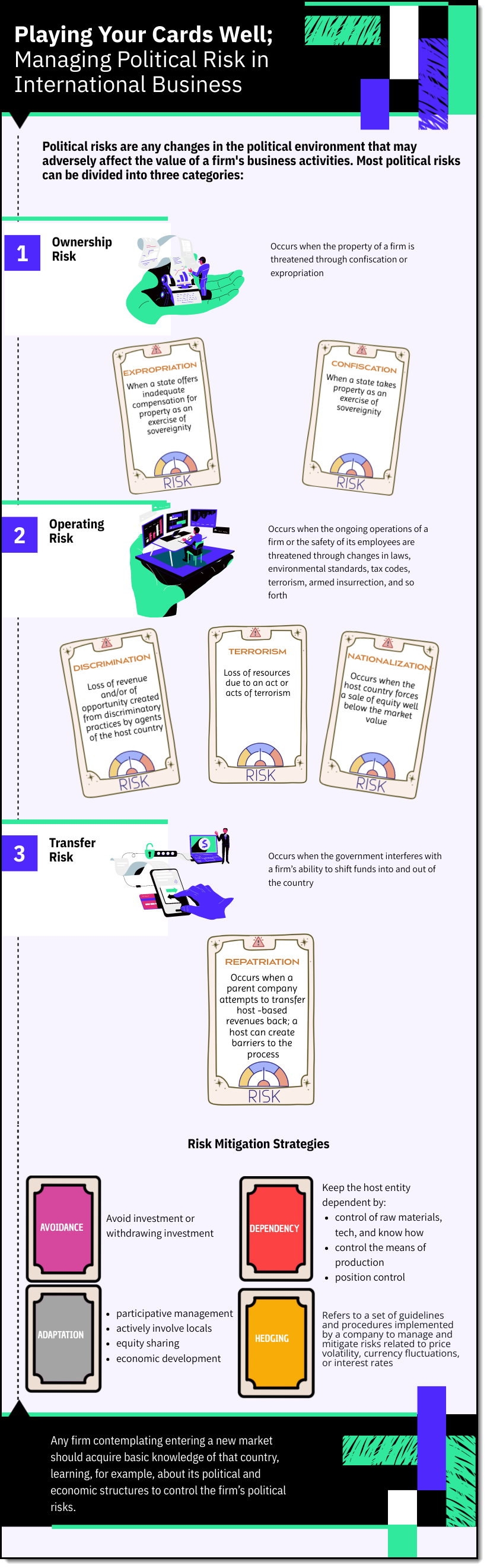
Playing Your Cards Well

Use this political-risk visual to consider how firms anticipate exposure and respond to government action or instability.

Playing Your Cards Well political risk infographic
Deep Dive Legal, Technological, and Political Environments podcast thumbnail
Listen

Deep Dive: Legal, Technological, and Political Environments

Use the podcast as another way to review how legal systems, technology transfer, political intervention, and country risk shape international-business decisions.

Listen to the Deep Dive
Week 3 Glossary

Key terms for legal, technological, and political environments

Use these definitions as a quick reference during Week 3 and before the knowledge check.

Arbitration

A process by which parties to a conflict agree to submit their case to a private individual or body whose decision they will honor.

Bureaucratic Law

The law of a country, usually a communist country or a dictatorship, that is whatever the country’s bureaucrats say it is, regardless of the formal law of the land.

Civil Law

A legal system based on a detailed listing, or codification, of what is and is not permissible.

Comity

The principle that a country will honor and enforce within its own territory the judgments and decisions of foreign courts, with certain limitations.

Common Law

A legal system based on the cumulative wisdom of judges’ decisions on individual cases through history.

Confiscation

Nationalization of assets belonging to a foreign company without compensation.

Embargo

A comprehensive sanction against all commerce with a given country.

Expropriation

Nationalization of assets belonging to a foreign company where the host government compensates the private owners for the assets.

Extraterritoriality

Attempts by the home country government to regulate a firm's activities outside of the country's borders.

Foreign Corrupt Practices Act (FCPA)

A U.S. law that prohibits U.S. firms and individuals from paying bribes to foreign officials in order to obtain or retain business.

Forum Shopping

The process by which parties to a dispute each seek to have the case heard in the court system most favorable to their own interests.

Litigation

Legal proceeding conducted in a court of law.

Macropolitical Risk

A political risk that affects all firms in a country.

Micropolitical Risk

A political risk that affects only a specific firm or firms within a specific industry.

Multilateral Investment Guarantee Agency (MIGA)

A subsidiary of the World Bank that provides insurance against political risk.

Nationalization

When a government takes possession of assets belonging to a foreign company.

Operating Risk

The risk that the ongoing operations of the firm and/or the safety of its employees are threatened through changes in laws, environmental standards, tax codes, terrorism, and so forth.

Ownership Risk

The risk that the property of the firm is threatened through confiscation or expropriation.

Overseas Private Investment Corporation (OPIC)

A U.S. government agency that provides insurance to firms against political risk.

Political Risk Assessment

A systematic analysis of the political risks faced by international businesses in foreign countries.

Privatization

The conversion of state-owned property to privately owned property.

Religious Law

A legal system based on the officially established rules governing the faith and practice of a particular religion.

Sanctions

Restraints against commerce with a country.

Statutory Law

Laws enacted by legislative action.

Technology Transfer

The transmission of technical knowledge and skills from one country or organization to another.

Theocracy

A country that follows religious law.

Transfer Risk

The risk that the government interferes with the firm’s ability to shift funds into and out of the country.

Week 3 Knowledge Check

Playing Your Cards Well

The Week 3 check is an individual, scenario-based version of Playing Your Cards Well. You will read 10 short international-business risk situations and play one of four political-risk mitigation cards: Avoidance, Adaptation, Dependency, or Hedging.

Complete this last: finish the Week 3 activities and review the resources and glossary above before beginning the knowledge check.
Looking ahead: Week 4 shifts from the external environment to culture and asks how differences among societies shape managerial assumptions, behavior, communication, and business practice.