Week 2 Focus

Where are the opportunities?

Developed economies remain some of the world's largest and wealthiest markets. At the same time, many emerging economies offer faster growth, expanding consumer demand, and changing patterns of trade and investment. This week asks you to look beyond labels such as developed and emerging and begin comparing markets with evidence.

Big question: If developed markets are large, wealthy, familiar, and relatively stable, why would a business deliberately pursue opportunities in an emerging economy?
75 min • in person~75 min • asynchronousMarket evidenceComparison + judgment

Global Markets Overview

In Person • Compare established and emerging opportunities

We begin by examining where economic activity is concentrated today and how the global marketplace has been changing. The goal is not to memorize a list of regions. Instead, use the evidence to ask why a firm might remain in mature developed markets—or deliberately seek growth elsewhere.

Class discussion

  1. ObserveWhat do the global-market graphics suggest about where wealth and economic activity are concentrated?
  2. CompareWhat advantages do developed markets offer firms?
  3. ChallengeIf those advantages are substantial, why pursue emerging economies?
  4. InferWhat information would a manager need before calling one market more attractive than another?

Building Global Skills: Market Snapshot

Solo exercise • time permitting. Choose one country and use World Bank data to create a concise market snapshot. Use the most recent available observation for each measure and record the year reported.

  • 1. Country
  • 2. GDP, PPP
  • 3. GDP growth
  • 4. GDP per capita, PPP
  • 5. Unemployment rate
  • 6. Gini Index
  • 7. Exports of goods & services
  • 8. Imports of goods & services
Finish with judgment: Based only on these indicators, what makes this market potentially attractive—or unattractive—to an international business?
Primary PESTLE + Consulting Gig

Asynchronous • Individual environmental-scan interaction

This asynchronous interaction combines the Picking Primary PESTLE and Consulting Gig portions of the Chapter 3 OER into a guided HTML experience. The consulting task uses Venturea Inc. and asks you to identify the political and legal barriers it could face in the assigned market and recommend how it should respond.

Your workflow

  1. AssignWork as a consultant to Venturea Inc. in one of six randomly assigned markets—Venezuela, Argentina, Japan, India, China, or Bangladesh.
  2. ScanIdentify the political, economic, sociocultural, technological, legal, and environmental signals that are present.
  3. PrioritizeSelect the primary PESTLE force and defend why it matters more than the secondary forces in the case.
  4. ConsultIdentify the legal and political barriers Venturea could encounter.
  5. RecommendJudge whether the barriers are manageable and deliver a concise evidence-based strategy.
PESTLE rule: the strongest answer is not the one that identifies the most categories. It is the one that makes a defensible case for which external force should receive Venturea's managerial attention first.
Submission: complete the guided environmental-scan form, download the Word-readable consulting report, and upload it to the Week 2 Brightspace assignment.
How the pieces connect

From market labels to market evidence

The in-person session begins with a broad comparison of developed and emerging markets, then asks you to investigate one country using comparable economic indicators. The asynchronous PESTLE exercise extends that investigation beyond economic indicators: identify external forces, determine which matters most, and recommend how Venturea should respond.

Week 2 Resources

See the marketplace. Then examine the data behind it.

Begin with the video. Hover over either infographic to enlarge it; click to open a large static view.

Redrawing the Economic Map

Review how the geography of global economic activity has shifted and why managers need to look beyond traditional market centers.

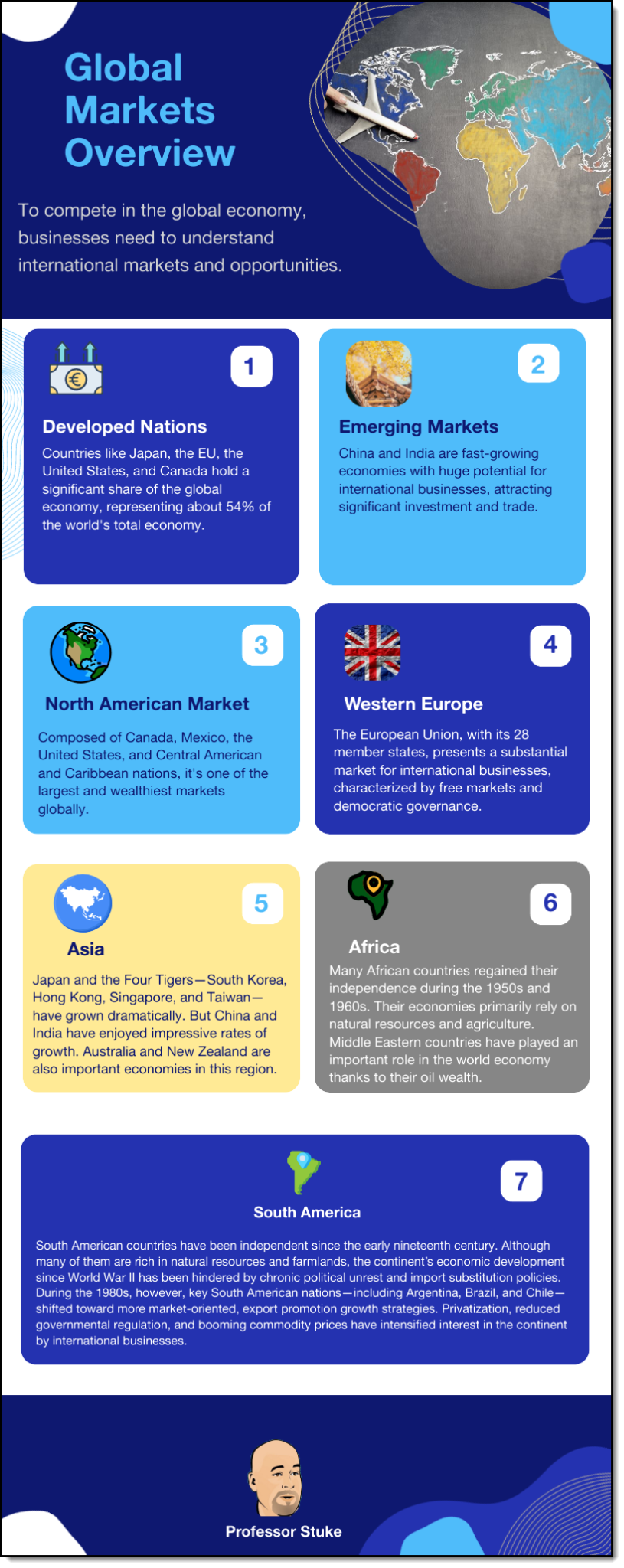
Global Markets Overview

Use this visual to compare major regions and the different roles they play in the international marketplace.

Global Markets Overview infographic
Hover to enlarge • click for large view

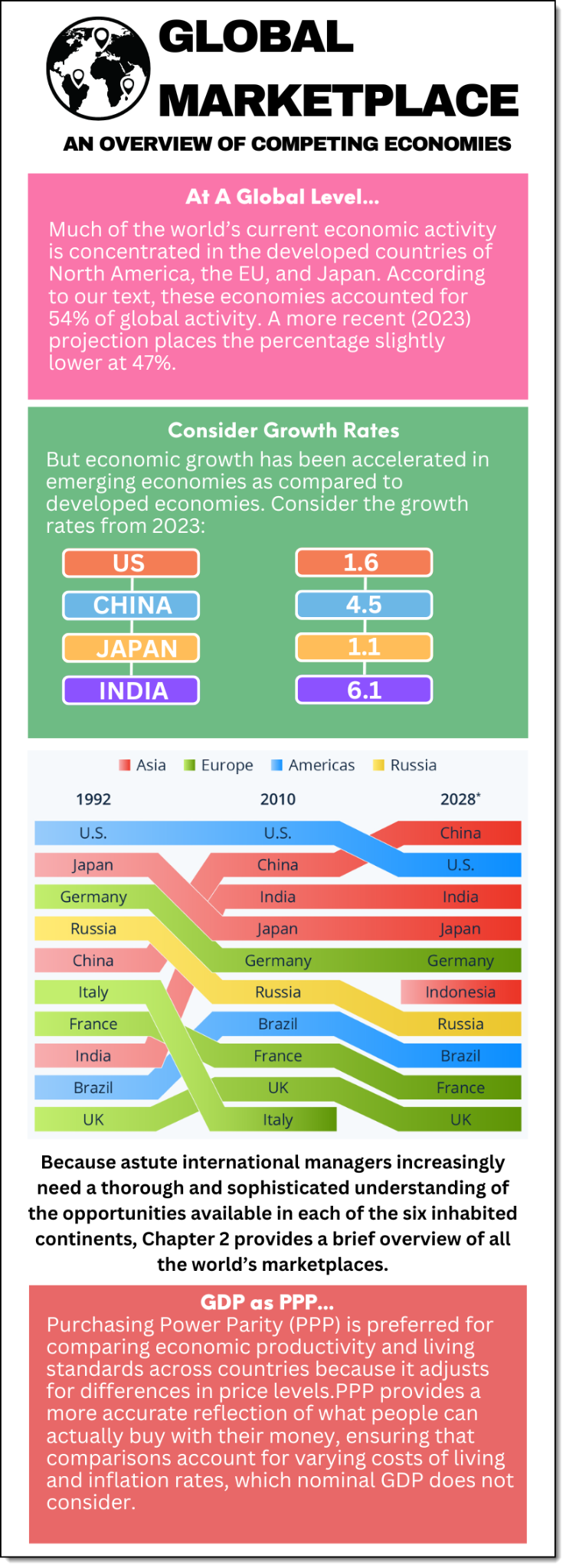
Global Marketplace

Use this visual to consider concentration, growth, purchasing power, and the changing rank of major economies.

Global Marketplace infographic
Hover to enlarge • click for large view
Deep Dive Global Marketplaces podcast thumbnail
Listen

Deep Dive: Global Marketplaces

Use the podcast as another way to review how mature and emerging markets differ, why global economic activity shifts over time, and what those changes mean for international managers.

Listen to the Deep Dive
Week 2 Glossary

Key terms for global marketplaces

Use these terms as a quick reference while comparing countries, regions, and patterns of international economic activity.

Bilateral Trading Relationship

A trade agreement or economic relationship between two countries.

Chaebol

Large, privately owned conglomerates in South Korea, such as Samsung, Hyundai, and Daewoo.

EU (European Union)

A political and economic alliance of European countries designed to promote trade and cooperation among member states.

FDI (Foreign Direct Investment)

An investment made by a company or individual in one country into business interests located in another country.

Flight Capital

Money that leaves a country seeking a safe haven due to political or economic instability.

Four Tigers

The high-growth economies of South Korea, Taiwan, Singapore, and Hong Kong.

GDP (Gross Domestic Product)

The total value of goods and services produced in a country in a year.

Invoicing Currency

The currency in which international trade transactions are denominated.

Keiretsu

A large family of interrelated firms in Japan, often with close relationships and cross-ownership.

MNC (Multinational Corporation)

A corporation that has facilities and other assets in at least one country other than its home country.

NAFTA (North American Free Trade Agreement)

A trade agreement between Canada, Mexico, and the United States that eliminated most tariffs and trade barriers.

Quad

The economic regions of the Triad (North America, the European Union, and Japan) plus Canada.

Sogo Soshas

Export trading companies in Japan that serve as marketers for the keiretsu in international markets.

Triad

The economic regions of North America, the European Union, and Japan, which represent the major centers of economic activity.

Week 2 Knowledge Check

Monsters: Global Market Challenge

Complete the individual Monsters knowledge check after the Week 2 activities and review. The challenge reinforces market size, market growth, purchasing power, inequality, and developed versus emerging economies.

Monsters Global Market Challenge splash screen
Complete this last: Use the resources and glossary above before beginning the knowledge check.
Looking ahead: Week 3 moves from comparing markets to scanning the broader business environment. You will examine how external conditions can create opportunities, constraints, and risks for firms operating across borders.