Treat culture as a business variable: identify meaningful differences, use cultural frameworks carefully, and translate them into decisions about how Venturea should cross borders.
Week 4 Focus
Week 4 Focus
International managers do not enter culturally neutral markets. Assumptions about hierarchy, individual responsibility, risk, time, achievement, communication, and relationships can influence how customers buy, how employees respond to managers, and how partnerships are built. This week introduces culture as a source of both opportunity and friction.
Big question: Which cultural differences are strategically important for Venturea—and which are merely interesting?
75 min • in person~75 min • asynchronousHofstede + interpretationVenturea across borders
Culture Lens: Four Lands
In Person • From cultural dimensions to market viability
Opening prompt: What makes the examples funny—and what makes the same differences potentially expensive for an international business?
Brief lecture • Culture as a business variable
Culture shapes shared assumptions about how people should behave, communicate, make decisions, build relationships, interpret authority, and respond to uncertainty. Managers therefore need to move beyond simply noticing difference and ask a harder question: what does this difference mean for the firm?
Use cultural frameworks as lenses, not labels. Country-level scores can help structure comparison, but they do not describe every individual and should not replace evidence, context, or managerial judgment.
Hofstede's six dimensions
Power DistanceHow readily unequal distributions of power and hierarchy are accepted.
IndividualismWhether people tend to emphasize individual autonomy or group obligations.
AchievementThe relative emphasis placed on competition, performance, recognition, and achievement.
Uncertainty AvoidanceHow strongly people prefer predictability, structure, rules, and reduced ambiguity.
Long-Term OrientationThe degree to which a culture emphasizes future rewards, persistence, and adaptation over short-term results.
IndulgenceThe degree to which gratification, enjoyment, and personal freedom are encouraged rather than restrained.
Team task: access the Four Lands project, review Venturea and the cultural/economic evidence, select any three of the six dimensions, and make a concise market-viability recommendation. Up to six team screens feed a shared class page.
Culture Club gives you a market and activity code, then sends you into the Venturea Culture Coach to build a culturally informed pitch and determine the most advantageous mode of entry.
Your workflow
AssignEnter the Culture Club page and receive a locked real-world market plus your unique CC activity code.
ConnectBe signed in to ChatGPT. A free ChatGPT account is sufficient. Paste both the assigned country and exact CC code into Culture Coach when prompted.
PitchChoose one Venturea line: High-Efficiency Solar Panels, Next-Generation Wind Turbines, or Advanced Grid Storage Solutions.
CoachWork through the cultural implications of the market. Culture Coach will challenge your reasoning and guide you through the most advantageous mode-of-entry decision.
SubmitFinish the interaction, receive the final score, and approve the request to send the result to kurtstuke.com so it can be matched to your activity code.
CompareUse the shared Culture Club results to see how the same company requires different recommendations across borders.
Culture Club rule: do not treat a cultural dimension as an answer by itself. The strongest recommendation explains how a cultural characteristic changes what Venturea should actually do.
New concept alert: mode of entry is introduced here as just-in-time support rather than assumed prior knowledge. Culture Coach and the mode-of-entry guide will help you reason through the options.
The in-person activity asks teams to use Hofstede's dimensions to compare the fictional Four Lands and decide which cultural signals matter most for Venturea. The asynchronous Culture Club then transfers that same logic to a real country: identify the salient cultural issue, connect it to Venturea, and convert the insight into a practical cross-border recommendation.
Week 4 Resources
Watch first, then use the visuals as references.
The Chapter 4 videos are now grouped at the top of the resource section. Use them first, then review the infographics and podcast below.
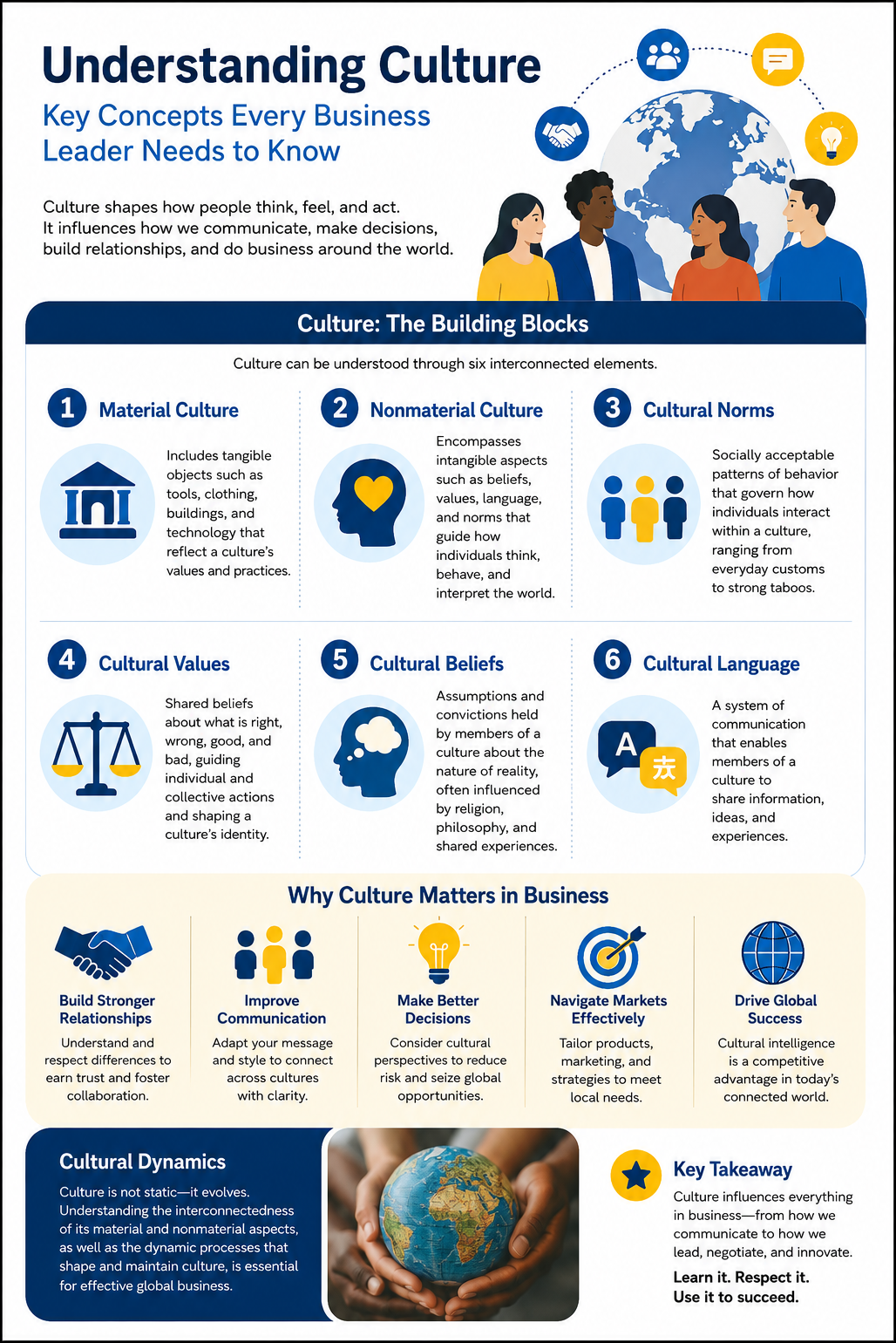
A concise overview of culture's building blocks—material and nonmaterial culture, norms, values, beliefs, and language—and why those elements matter for global business.
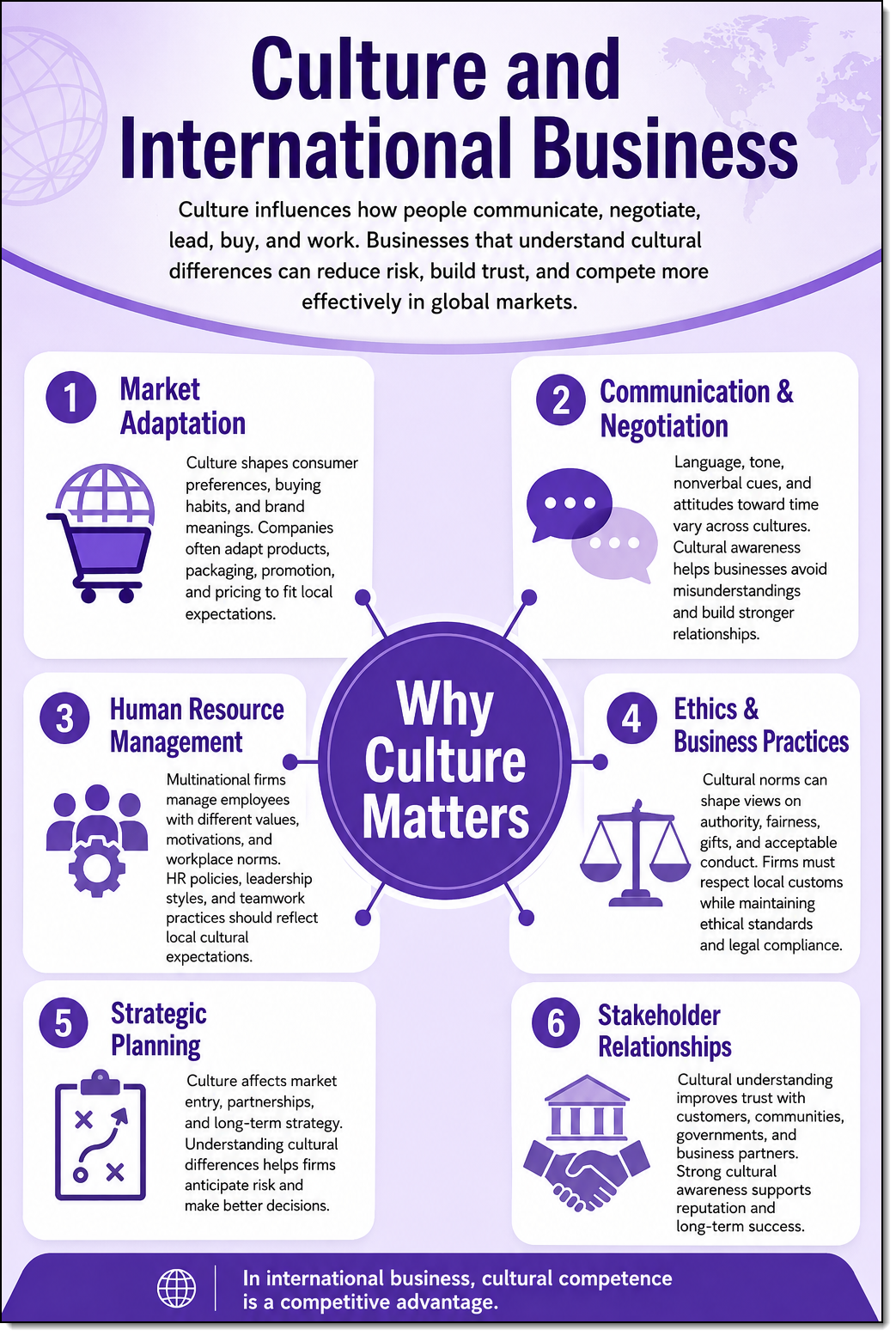
Culture and International Business
A business-focused view of how culture affects market adaptation, communication and negotiation, human resources, ethics, strategic planning, and stakeholder relationships.
Listen
Deep Dive: Culture and International Business
Use the podcast as another way to review how culture shapes communication, hierarchy, relationships, managerial assumptions, and cross-border business choices.
Use these definitions as a quick reference while completing Culture Lens, Culture Club, and the Week 4 Knowledge Check.
Culture
The collection of values, beliefs, behaviors, customs, and attitudes that distinguish a society.
Social Structure
The overall framework that determines the roles of individuals within a society, the stratification of a society, and individuals’ mobility within a society.
Social Stratification
The categorizing of people on the basis of their birth, occupation, educational achievements, and/or other attributes.
Social Mobility
The ability of individuals to move from one stratum of society to another.
Values
The principles and standards accepted by members of a society.
Attitudes
The actions, feelings, and thoughts that result from those values.
Low-Context Culture
A culture in which communication is explicit and direct.
High-Context Culture
A culture in which communication relies heavily on implicit cues and nonverbal signals.
Cultural Cluster
A group of countries that share many cultural similarities.
Individualism
The cultural belief that the person comes first.
Collectivism
The belief that the group comes first.
Power Respect
The acceptance of the power and authority of superiors based on their position in the hierarchy.
Power Tolerance
Less significance attached to a person’s position in the hierarchy.
Uncertainty Acceptance
The feeling that people have regarding uncertain and ambiguous situations that are stimulating and offer opportunities.
Uncertainty Avoidance
Disliking and avoiding ambiguity.
Aggressive Goal Behavior
Placing a high premium on material possessions, money, and assertiveness.
Passive Goal Behavior
Placing a higher value on social relationships, quality of life, and concern for others.
Long-Term Orientation
A focus on the future and perseverance.
Short-Term Orientation
A focus on the past and present and immediate gratification.
Indulgence
A cultural orientation that values leisure time, pleasure, and optimism.
Restraint
A cultural orientation that emphasizes self-control and regulating the actions of cultural members.
Cultural Convergence
The growing similarity of cultures as a result of improvements in communication and transportation.
Self-Reference Criterion
The unconscious use of one’s own culture to assess new surroundings.
Cross-Cultural Literacy
Understanding and adapting to cultural differences.
Week 4 Knowledge Check
Culture Signal Decoder
Finish the week with a 10-question randomized knowledge check based on the Chapter 4 culture glossary. Each item presents a business situation and asks you to identify the cultural concept that best explains what is happening.
Looking ahead: Week 5 moves from broad cultural comparison to culture in action, including language, communication context, religion, and other forces that shape how international business is conducted.