Week 13 Focus: International Marketing

Choosing a foreign market and a mode of entry is only part of the challenge. A firm must also give customers a compelling reason to buy—and make its offering affordable, understandable, and available. This week explores how the marketing mix changes when business crosses national borders.

We will use the Four Ps—product, price, promotion, and place—to examine what a company can standardize and what it should adapt. Culture, purchasing power, competition, regulation, and distribution systems can all change how an offering reaches customers. The goal is to make marketing choices that fit the target market and work together as a coherent business approach.

75 min in person~75 min asynchronousFour Ps • Standardization & adaptation

Weekly Design

In-Person: International Marketing

75 minutes

Venturea Product Lab

Work with your team to design Venturea’s energy-storage product for Eryndor. Apply your assigned ethnocentric, polycentric, or geocentric approach to five product decisions: features, branding, packaging, warranties, and service. Support each choice with a market fact and explain its tradeoff.

Think through your assigned perspective. In Rounds 1 and 2, use your team’s approach to guide your choices. You may choose a policy that reflects another approach, but explain why. After you lock in, review the alignment feedback; an aligned choice still needs evidence that it fits the market.

In Round 1, build your Eryndor product package. In Round 2, test your choices against Brayland’s conditions and decide what should change. In Round 3, set aside your assigned approach and recommend a final package for both markets. Identify what Venturea should keep common and what should vary locally. Your instructor opens each round; use one device to submit your team’s decisions.

Launch Venturea Product Lab

Asynchronous: International Marketing

Approximately 75 minutes

Venturea: Reach the Customer

Work individually to build a promotion and distribution plan for Venturea. Choose solar panels or grid storage, receive one assigned Four Lands market, and review its economic and cultural brief.

Make a promise Venturea can deliver. An effective message needs a distribution system that can reach customers, install the product, and honor its service commitments. Use cultural indicators as questions to investigate rather than assumptions about every buyer.

Make five decisions about the distribution channel, message, communication channel, credibility, and customer offer. Review the feedback after each choice, then respond to a market setback. Finish with a 100–150-word recommendation using two market facts, one promotion–distribution connection, one tradeoff, and an assumption you would verify.

Enter your name and class section. Submit your recommendation to the instructor console and download your report. Allow approximately 15–20 minutes for the activity; use the remaining asynchronous time to review the Four Ps resources and podcast.

Launch Reach the Customer

Resources: The Four Ps

Review the infographics below. Hover to magnify; select an infographic to open the full-size image.

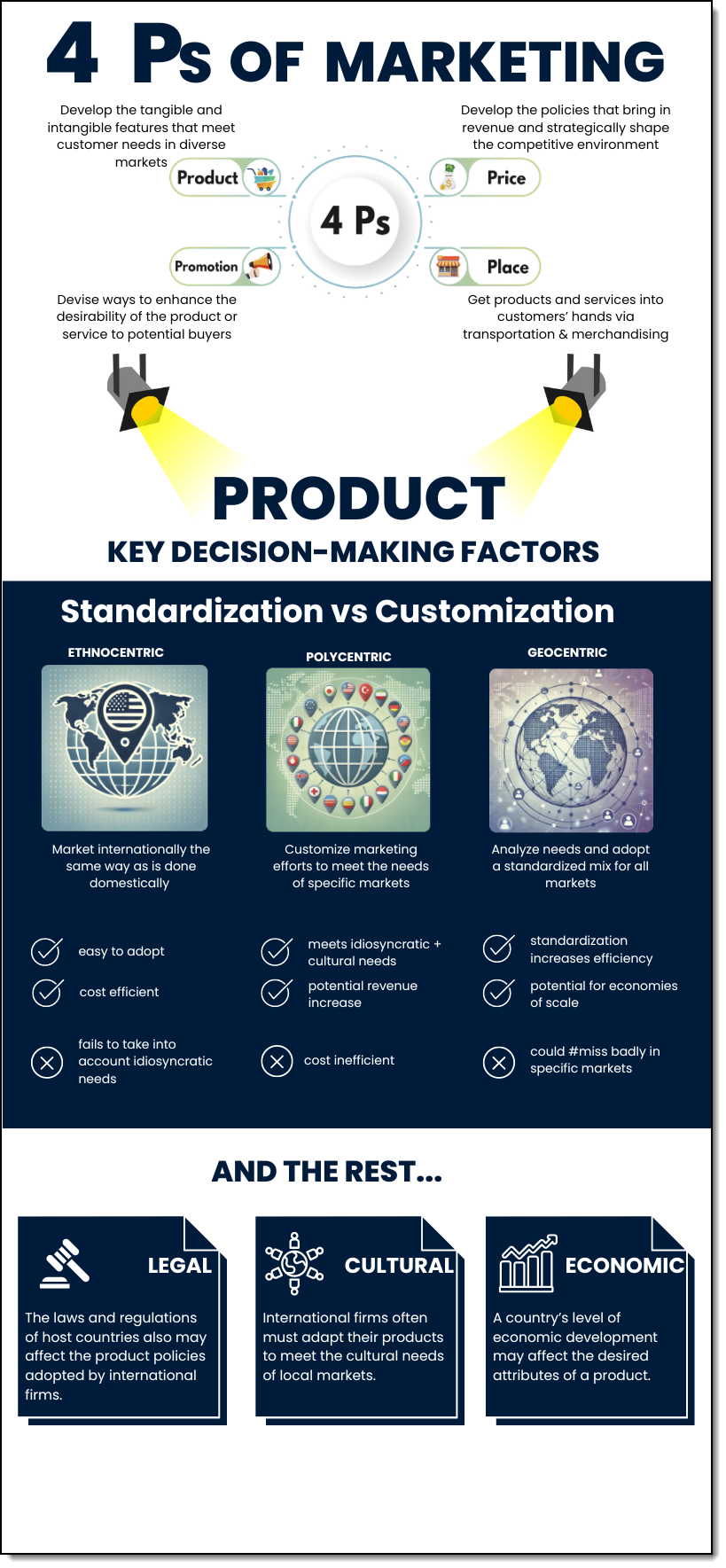
Product

Four Ps: Product infographic

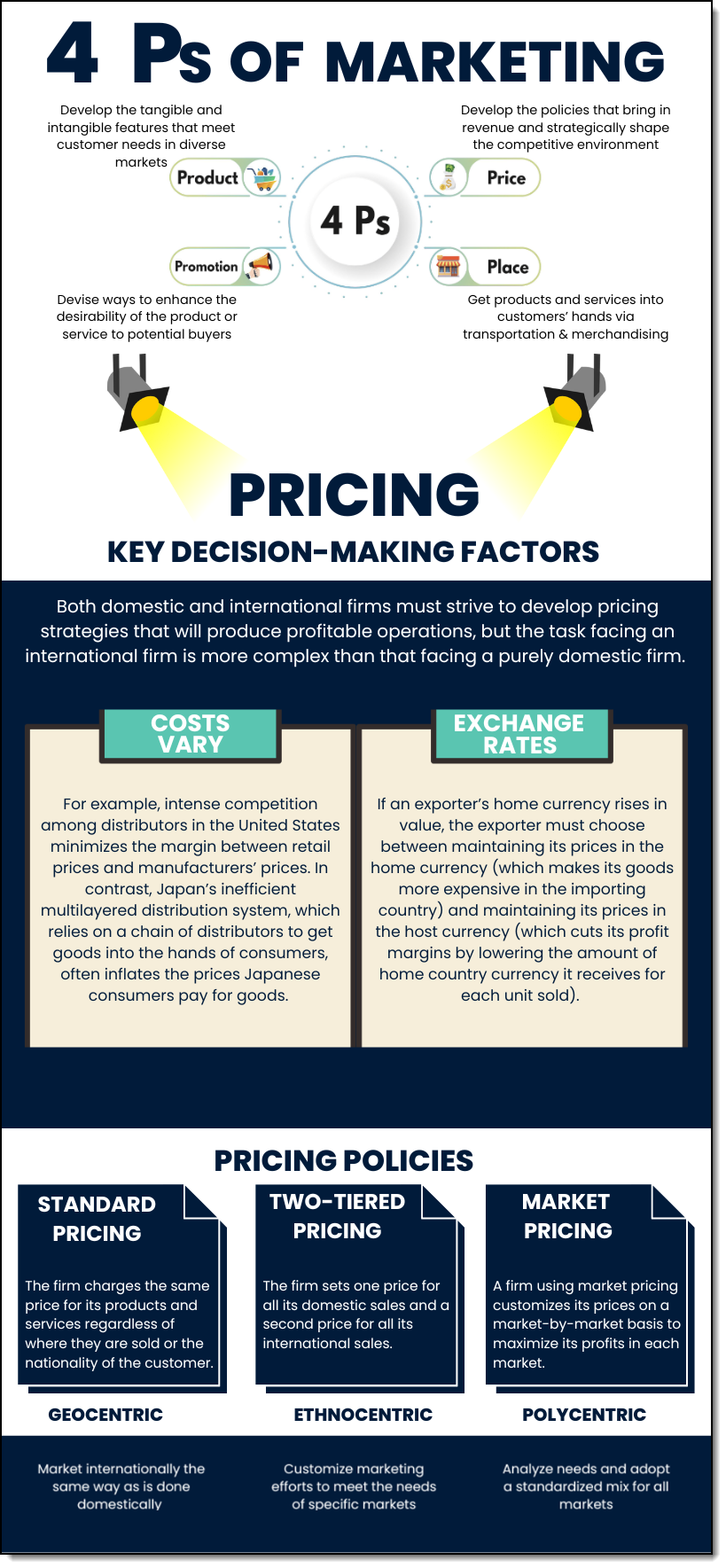
Pricing

Four Ps: Pricing infographic

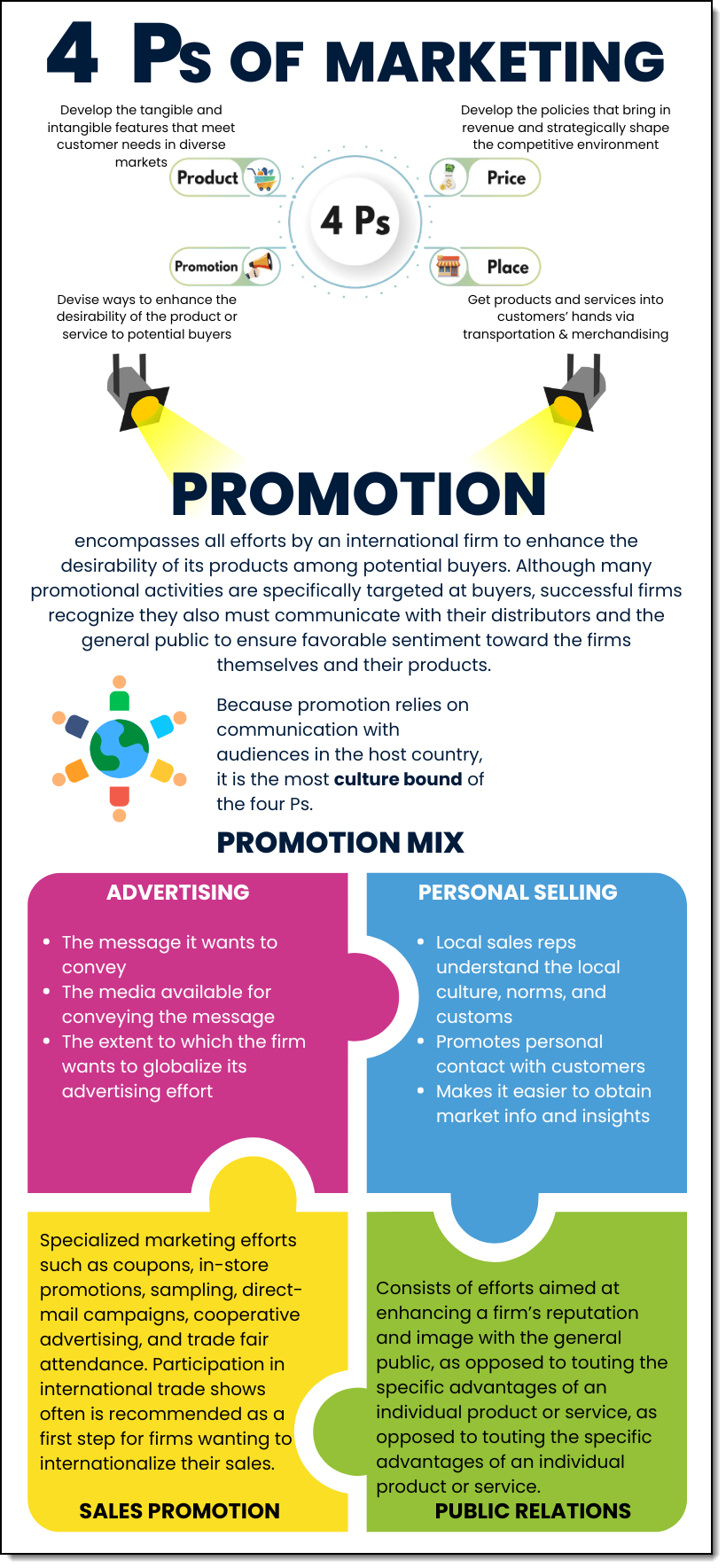
Promotion

Four Ps: Promotion infographic

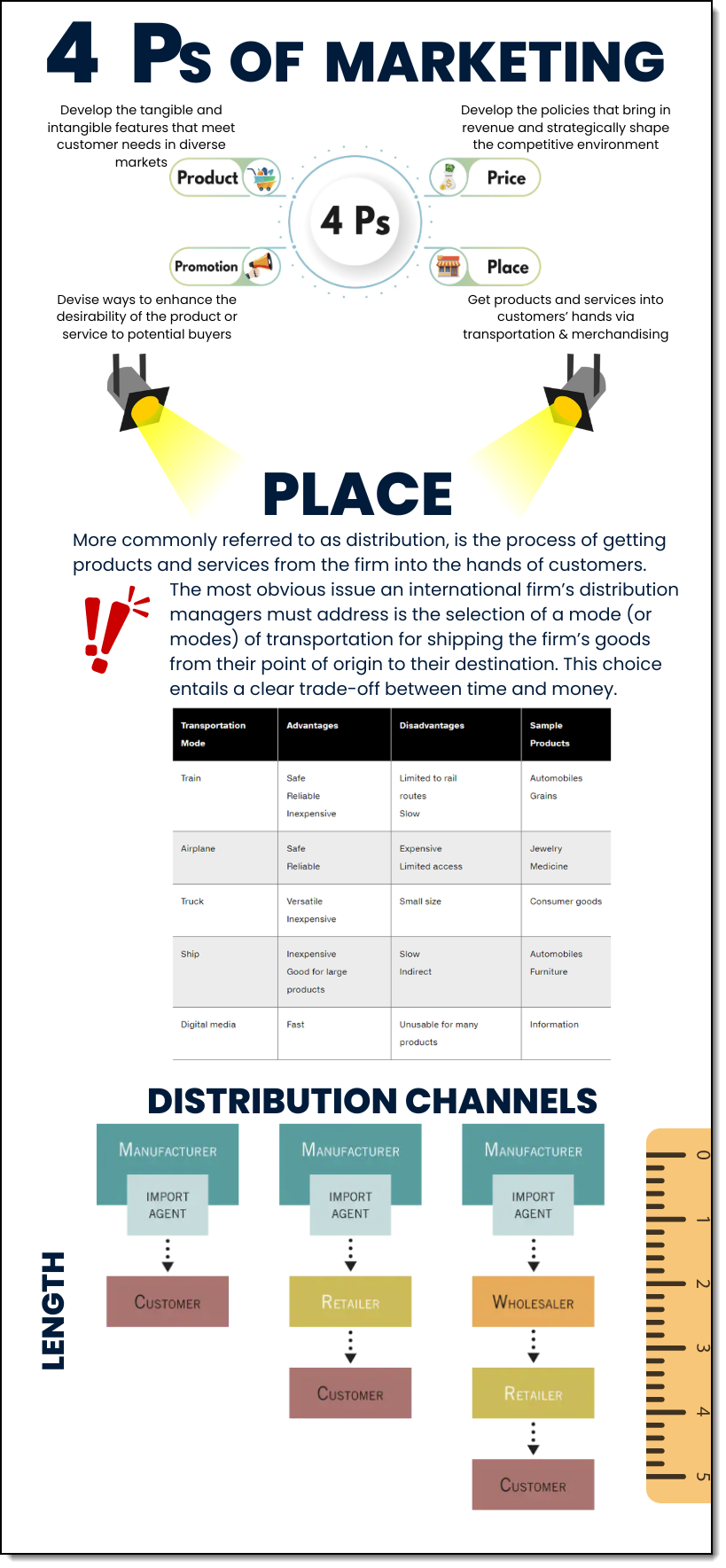
Place

Four Ps: Place infographic

Deep Dive: The Four Ps of Marketing

Deep Dive podcast: The Four Ps

Listen to the Deep Dive episode on the Four Ps of marketing as you review product, price, promotion, and place.

Listen to the Podcast ↗

Week 13 Glossary

International Marketing: The extension of the process of planning and executing the conception, pricing, promotion, and distribution of ideas, goods, and services across national boundaries to create exchanges that satisfy individual and organizational objectives.

Standardization: In international marketing, the strategy of marketing products internationally in the same way a firm does domestically, using a largely uniform marketing mix across all markets.

Customization: In international marketing, the strategy of adapting the marketing mix to meet the specific needs and preferences of each individual target market.

Ethnocentric Approach: An approach to international marketing where a firm markets its products internationally in the same way it does domestically, assuming what works at home will work abroad.

Polycentric Approach: An approach to international marketing where a firm customizes its marketing mix to meet the specific needs of each individual foreign target market.

Geocentric Approach: An approach to international marketing where a firm coordinates its marketing mix using evidence from markets worldwide, seeking global efficiency through a shared core and justified local variations.

Marketing Mix (Four Ps): The key elements of a marketing strategy, encompassing product, price, promotion, and distribution, which marketers manipulate to achieve their marketing objectives.

Product Policy: Decisions related to the tangible and intangible aspects of a product offered in international markets, including features, branding, packaging, warranties, and service.

Pricing Policy: The strategy a firm adopts for setting prices in international markets, such as standard pricing, two-tiered pricing, or market pricing.

Standard Pricing: An international pricing policy where the same price is charged for a product regardless of where it is sold or the nationality of the customer.

Two-Tiered Pricing: An international pricing policy where one price is set for all domestic sales, and a second, different price is set for all international sales.

Market Pricing: An international pricing policy where prices are customized on a market-by-market basis to reflect local demand, competition, and costs.

Gray Market (Parallel Importing): A market that results when products are imported into a country legally but outside the normal channels of distribution authorized by the manufacturer.

Promotion Mix: The various communication tools a firm uses to enhance the desirability of its products among potential buyers, including advertising, personal selling, sales promotion, and public relations.

Advertising: Any paid form of nonpersonal presentation and promotion of ideas, goods, or services by an identified sponsor in international markets.

Personal Selling: Making sales on the basis of direct, personal contact with customers in international markets.

Sales Promotion: Short-term incentives to encourage the purchase or sale of a product or service in international markets, such as coupons, samples, and trade fair participation.

Public Relations: Efforts aimed at enhancing a firm’s reputation and image with the general public in international markets, often focusing on corporate citizenship.

Distribution Channel: The set of individuals and organizations involved in the process of making a product or service available for use or consumption by the consumer in international markets.

Channel Length: The number of stages in a distribution channel, ranging from direct sales to longer channels involving wholesalers and retailers.

International Order Cycle Time: The total time between the placement of an order by an international customer and the receipt of that order.
Week 13 Knowledge Check

International Marketing Knowledge Check

Complete an individual, 10-question review of the Four Ps, international marketing approaches, pricing policies, promotional tools, and distribution. Each attempt draws from a 30-question pool, with two questions from each topic area.

Compare the concepts carefully. Some choices describe closely related ideas. Select the best answer for the specific situation, then use the explanation to review the distinction.

Enter your name and class section. Answers appear one at a time and repeat until you select a choice; you can pause or show all choices at any point. There is no time limit. Submit your result to the instructor console after completing all 10 questions. Allow approximately 8–12 minutes.

Launch Week 13 Knowledge Check
Looking ahead: Week 14 brings your market analysis, entry-mode choices, and international marketing decisions together in the Four Lands Decision Lab. Your team will evaluate Venturea’s project options, compare revenue and payback, and revise its recommendation as new information changes the decision.