Week 12 Focus

Compare exporting, licensing, franchising, specialized contracts, and foreign direct investment. Weigh control, resource commitment, cost, and risk to decide how a firm should enter its chosen market.

75 min in person~75 min asynchronousModes of Entry

Your Week 12 Activities

In-Person Session

75 minutes

Mode of Entry Game

Explore the major modes of foreign-market entry using the interactive console, then test your understanding in the built-in game. Review definitions, advantages, and disadvantages as you move through the seven entry modes.

Launch Mode of Entry Game

Mode of Entry Team Exercise

Work through a series of international expansion decisions. Your team will need to match the conditions of a foreign market with an appropriate entry strategy while balancing control, commitment, cost, and risk.

Be ready to explain the tradeoff behind your choice. The goal is not simply to name an entry mode, but to defend why it fits the situation better than the alternatives.

Launch Mode of Entry Team Exercise
Defend your choice. Explain how your entry mode balances control, resource commitment, costs, and risk in the situation you face.

Asynchronous Session

Approximately 75 minutes

Entry Mode Challenge

Build Venturea’s international portfolio by collecting one opportunity in each of three rounds. Review each card’s entry mode, setup costs, annual revenue, and recurring costs. Compare five-year outcomes, choose an opportunity, and explain the financial evidence and tradeoff behind your decision.

Think about the whole portfolio. Revenue alone is not profit. Include setup and recurring costs in every choice, then evaluate your combined net return and ROI using the portfolio totals.

Lock one choice per round and continue to the next. Your choices remain in the portfolio ledger. After Round 3, open the Sandbox and reimagine either the Brayland contract-manufacturing deal or the Noveria acquisition. Use AI-assisted research to support three analyses: setup costs, operational costs, and revenue. Keep each input within ±10% and show evidence and calculations that justify the change. This prepares you for your upcoming team project. Complete all three rounds to see whether your portfolio produces a profit, breaks even, or generates a loss. In the turnkey round, count each project fee once rather than multiplying it by five.

Resources

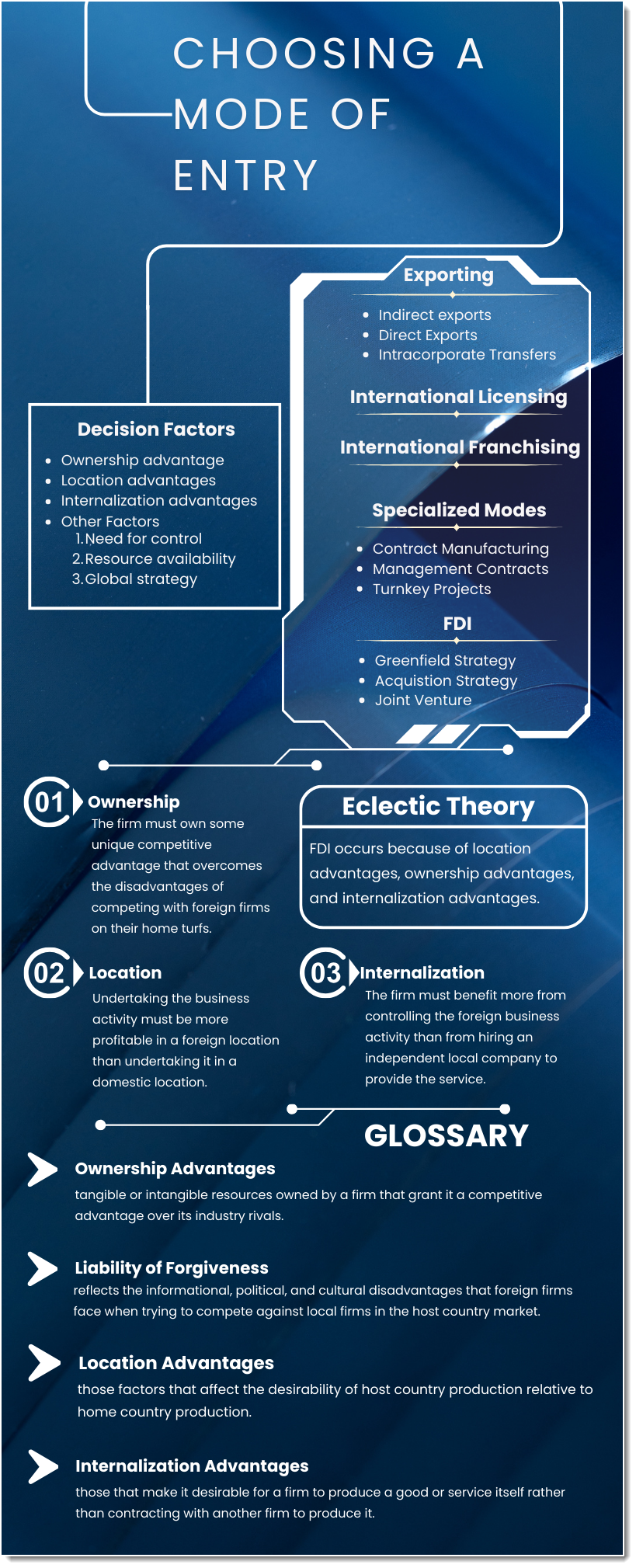
Choosing a Mode of Entry and the OLI framework

Choosing a Mode of Entry

Exporting, licensing, franchising, specialized modes, FDI, and the OLI framework.

Week 12 Glossary

Exporting: The process of sending goods or services from one country to another for use or sale.

Foreign Direct Investment (FDI): An investment made by a company or individual in one country into business interests located in another country, giving the investor control over the acquired assets.

Greenfield Strategy: A type of FDI where a company builds new facilities from the ground up in a foreign market.

Acquisition Strategy (Brownfield Strategy): A type of FDI where a company purchases an existing business in a foreign market.

Licensing: An arrangement where a firm (licensor) grants another firm (licensee) the rights to use its intellectual property (e.g., patents, trademarks, copyrights) in exchange for a fee (royalty).

Franchising: An agreement where a firm (franchisor) grants an independent operator (franchisee) the right to operate a business under its name, using its business model, in exchange for fees and adherence to operating standards.

Contract Manufacturing: An arrangement where a firm outsources its manufacturing to a third-party company, often in a foreign country, to reduce costs or gain efficiency.

Management Contract: An agreement where one company provides managerial assistance, technical expertise, or specialized services to another company for a specified period in return for a fee.

Turnkey Project: A contract under which a firm agrees to fully design, construct, and equip a facility and then hand it over to the purchaser in a ready-to-operate state.

Export Management Company (EMC): A firm that acts as the export department for one or more client companies, providing expertise in international marketing, logistics, and finance.

Dunning's Eclectic Theory: A framework explaining the extent and pattern of international production, based on the interplay of ownership advantages, location advantages, and internalization advantages.

Market Potential: The total demand for a product or service in a particular market, often assessed by factors like population, GDP, and consumption patterns.

Trade Barriers: Government-imposed restrictions on the free flow of goods and services across borders, such as tariffs and quotas.

Sociocultural Influences: The customs, beliefs, values, and behaviors of a society that can impact business decisions and consumer preferences in a foreign market.
Knowledge Check

Week 12 Knowledge Check

Check how well you can distinguish entry modes, apply the OLI framework, compare costs and returns, and support proposed improvements with evidence. Review the glossary, Modes of Entry infographic, and your Entry Mode Challenge results before you begin.

Your next step: Answer 10 randomized questions. Read each question, compare the cycling answer choices, and select the best response. Your selection locks, then you receive feedback.

Open the Week 12 Knowledge Check →

Looking ahead: Week 13 turns from entering a market to reaching its customers. You will examine international marketing and consider how product, pricing, promotion, and placement decisions should respond to differences across markets.