Week 8 Focus

Classical theories explain much about specialization and factor endowments, but modern trade patterns also depend on the behavior of firms. Week 8 focuses on how market similarity, product evolution, economies of scale, industrial clustering, and national competitive systems help explain where firms compete and why some locations become especially powerful.

75 min in person~75 min asynchronousFirm-based trade theory

Weekly Design

In-Person: From Theory to Trade Strategy

75 minutes • Firm-based trade theories + live simulation

1. Four Modern Firm-Based Theories

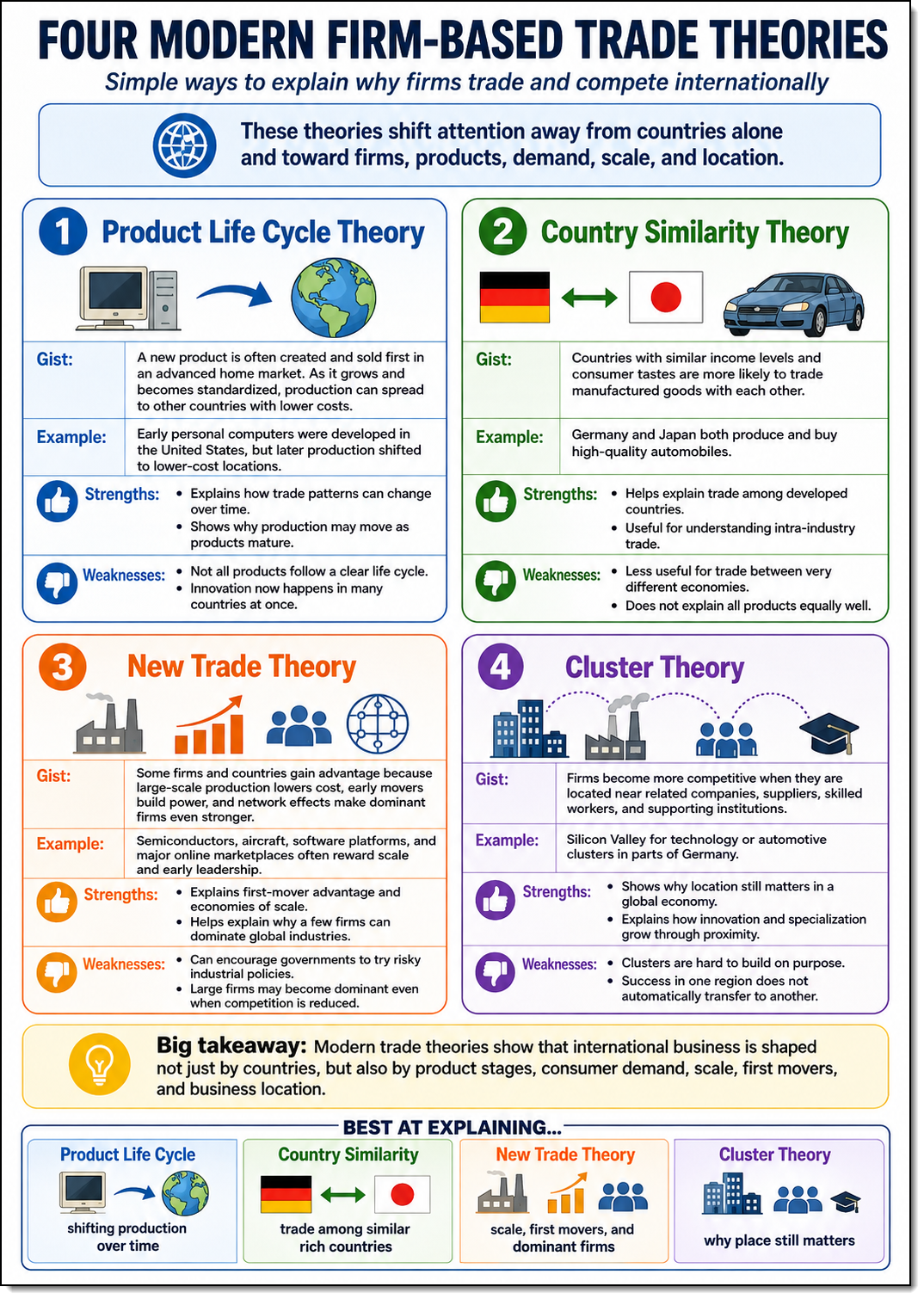
Use the four modern theories to shift the unit of analysis from the country to the firm and its products.

Country SimilarityProduct Life CycleNew Trade TheoryNational Competitive Advantage

2. Porter’s Diamond

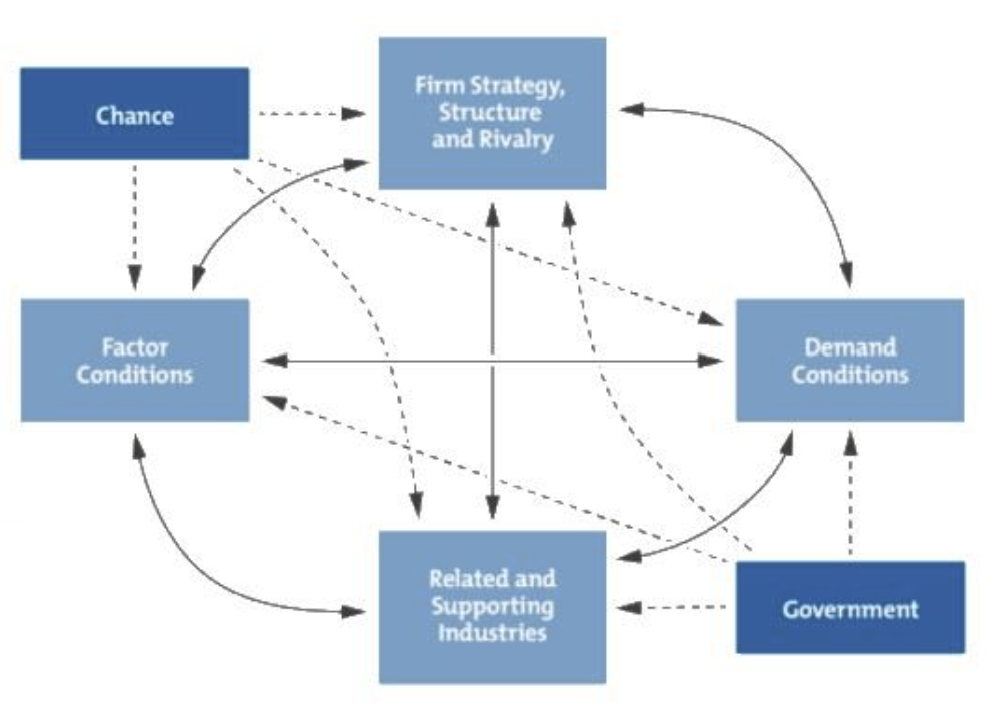
Use Porter’s Diamond to examine how factor conditions, demand conditions, related and supporting industries, and firm strategy/rivalry can reinforce one another and create a national environment that supports competitive firms.

3. Let’s Make a Deal — Round 1

Represent your assigned country in a live trade simulation. Negotiate exchanges that help your country secure priority imports while using its own exports strategically.

Round 1 focuses on the basic logic of trade, growth, resource access, and strategic exchange before tariffs are introduced in Week 9.

Asynchronous: Place Your Bet

Individual • Firm-based theory review

Place Your Bet is a short review interaction built around the firm-based theories. Each question asks you to identify the theory or concept that best explains a business pattern, product shift, cluster, or competitive advantage.

What you are reviewing

Country SimilarityProduct Life CycleEconomies of ScaleNew Trade TheoryPorter’s DiamondCluster Effects

The wager mechanic reflects confidence, but the purpose is conceptual: distinguish which theory explains the business situation and why.

Resources

Begin with the video, then use the infographics and podcast to reinforce the differences among the firm-based theories.

Firm-Based Theories of International Trade

Review the modern theories used to explain trade in differentiated products and the international behavior of firms.

Firm-Based Trade Theories

Use this visual as a high-level comparison of country similarity, product life cycle, new trade theory, and national competitive advantage.

Firm-Based Trade Theories infographic

Hover to enlarge • click for large static view

Porter’s Diamond Model

Review the four interacting determinants of national competitive advantage and how chance and government can influence the system.

Porter's Diamond Model infographic
Deep Dive Firm-Based Trade Theories podcast thumbnail

Deep Dive: Firm-Based Trade Theories

Prefer to listen? Review why modern trade theories focus on firms, product evolution, scale, market similarity, clusters, and national competitive systems.

Listen to the Deep Dive

Week 8 Glossary

The Chapter 6 glossary is broader than Week 8, so this version keeps only the concepts that support firm-based trade theories.

Firm-Based Trade Theories

Modern explanations of international trade that focus on firms, differentiated products, competitive behavior, scale, innovation, and market structure rather than only national factor endowments.

Country Similarity Theory

The view that most trade in manufactured goods occurs between countries with similar levels of economic development and similar consumer demand.

Intraindustry Trade

Two-way trade in similar or differentiated products within the same industry, such as automobiles traded between two industrialized countries.

Interindustry Trade

Trade in products from different industries, often associated with differences in resources or production structures across countries.

International Product Life Cycle

A theory describing how production and trade patterns can change as a product moves from introduction to maturity and standardization.

New Product Stage

The early stage of the product life cycle in which innovation, close contact with customers, and home-market production are especially important.

Maturing Product Stage

The stage in which demand spreads internationally, production begins to move abroad, and cost considerations become more important.

Standardized Product Stage

The stage in which a product becomes more commodity-like, price competition intensifies, and production may shift toward lower-cost locations.

New Trade Theory (NTT)

The theory that scale economies and first-mover advantages can allow a limited number of firms to dominate global markets, even when countries have similar resource endowments.

Economies of Scale

Reductions in average cost that occur as a firm increases the volume of output it produces.

First-Mover Advantage

An advantage gained by entering a market early, building scale, experience, brand recognition, or network position before rivals.

National Competitive Advantage

Porter’s theory that international success can emerge from the interaction of factor conditions, demand conditions, related and supporting industries, and firm strategy, structure, and rivalry.

Factor Conditions

The quality and availability of productive inputs such as skilled labor, infrastructure, knowledge, and capital that support an industry.

Demand Conditions

The characteristics and sophistication of home-market customers that pressure firms to improve and innovate.

Related and Supporting Industries

Competitive supplier and partner industries that strengthen information flows, capabilities, innovation, and productivity.

Firm Strategy, Structure, and Rivalry

The domestic conditions shaping how firms are created, organized, managed, and challenged by local competitors.

Industrial Cluster

A geographic concentration of interconnected firms, suppliers, institutions, and specialized resources that can reinforce productivity, learning, and innovation.

Agglomeration Economies

Benefits firms receive from locating near related companies, suppliers, skilled workers, institutions, and knowledge networks.

Competitive Advantage

A distinctive capability, position, or resource that allows a firm to create greater value or compete more effectively than rivals.

Week 8 Knowledge Check

Firm-Based Trade Theories

Complete the firm-based theory Knowledge Check after the in-person and asynchronous activities. The questions focus on applying country similarity, product life cycle theory, new trade theory, economies of scale, and Porter’s national competitive advantage framework.

Looking ahead: Week 9 turns from explaining trade to international investment. You will examine FDI, portfolio investment, OLI logic, and the second round of Let’s Make a Deal.