Week 5 Focus

Week 5 Focus

Week 4 introduced broad cultural frameworks. Week 5 moves closer to the moment of action. International managers must decide how to communicate, schedule work, design products, build trust, and respond to practices that may be unfamiliar at home. Two lenses guide the week: faith and business in the in-person session, followed by high- and low-context communication in the asynchronous session.

Big question: How can a business adapt to culturally meaningful differences without turning those differences into stereotypes?
75 min • in person~75 min • asynchronousFaith + business adaptationCommunication context

Culture, Faith, & Business Adaptation

In Person • Treat faith as a business variable, not a stereotype

Religion can influence the rhythm and expectations of a market. Depending on the country and local context, faith may affect holidays, food choices, work schedules, consumer symbolism, financial practices, community obligations, ethical expectations, and the way relationships are built. The managerial challenge is to determine which of those influences actually matter for the business decision in front of you.

Analyst rule: a dominant faith tradition is a signal to investigate—not a shortcut for predicting how every customer, employee, or partner will behave. Practice varies across countries, communities, organizations, and individuals.

Four places to look for business impact

Customers & productsFood choices, symbolism, holidays, purchasing patterns, branding, and product adaptation.
People & operationsScheduling, observance, dress, workplace accommodations, family or community expectations, and travel.
Money & ethicsViews of fairness, stewardship, giving, responsibility, finance, and acceptable business conduct.
Relationships & trustRespect, reputation, community ties, hospitality, communication, and the expectations surrounding partnerships.

Team challenge

Your team will receive a country and a faith system. Your job is not to summarize the religion. Instead, identify the business implications that deserve a manager's attention and recommend how a firm should adapt.

  1. Step 1Form a team of 3–4 students.
  2. Step 2Receive your team number and assigned country / faith pairing.
  3. Step 3Open the shared activity and respond to the prompts for your assigned country and faith system. Focus on business consequences and practical adaptation rather than a general description of beliefs.
  4. Step 4Prepare to review your analysis with the class. Teams will normally appoint one spokesperson, but every team member should be ready to explain the reasoning behind the recommendation.
What a strong response does: it connects a local practice or expectation to a specific business consequence, then explains what the firm should do differently because of it.
Hi–Lo: Reading Between the Lines

Asynchronous • Hall's high- and low-context communication

Good international communication requires more than translating words. Edward T. Hall's high- and low-context distinction helps explain how much meaning people expect to find in the words themselves versus the surrounding context—relationships, status, silence, shared experience, and other cues.

Use Hall as a diagnostic lens: the goal is not to label entire countries. It is to notice when two people may be using different assumptions about how explicit a message should be and then adapt.

Asynchronous activity

In Hi–Lo, you will work through six short international business scenarios. In each one, a manager misreads a cross-cultural interaction. Your task is to:

  1. LearnReview the distinction between high- and low-context communication.
  2. DiagnoseIdentify the communication assumption that created the misunderstanding.
  3. RepairSelect the response most likely to improve clarity while respecting the counterpart's communication context.
  4. ReflectUse the feedback to compare what the words said with what the situation may have communicated.
Expect about 30–40 minutes. The activity is formative. Your Week 5 Knowledge Check will separately test your ability to apply Meyer's eight Culture Map dimensions.
Week 5 Resources

Faith, Context, and Cross-Cultural Communication

Use these resources to reinforce the two major ideas developed this week: faith can shape business expectations and practices, and communication depends on more than the literal words being spoken.

Embedded Videos

Global Business & Belief

Review how religious belief and practice can influence business decisions.

Cracking the Culture Code

Connect communication style and cultural interpretation to the everyday challenge of working across borders.


Infographics

Mouse over any infographic to enlarge it.

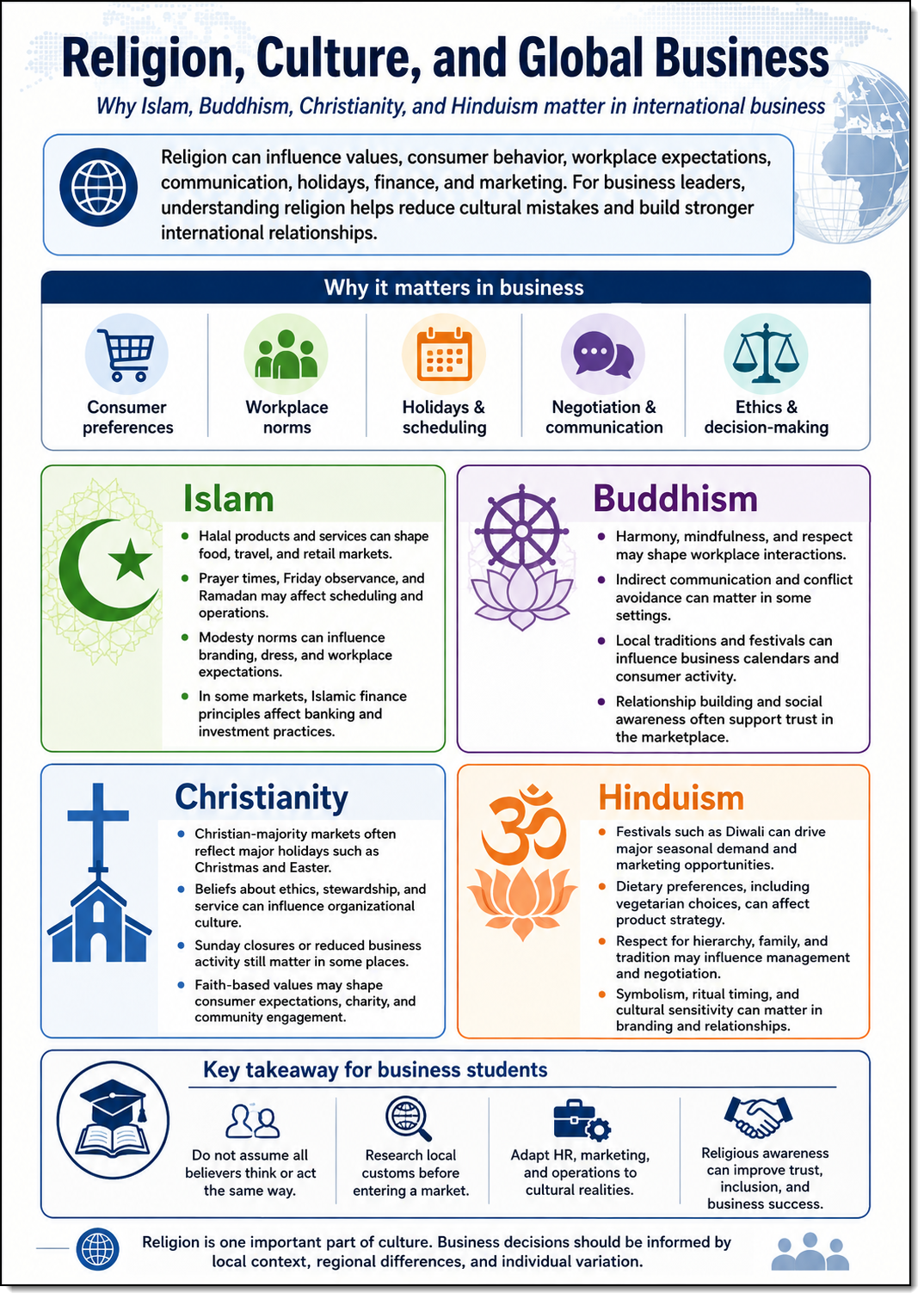
Religion, Culture, and Global Business

A high-level comparison of how Islam, Buddhism, Christianity, and Hinduism may intersect with international business.

Religion, Culture, and Global Business infographic
Mouse over to enlarge

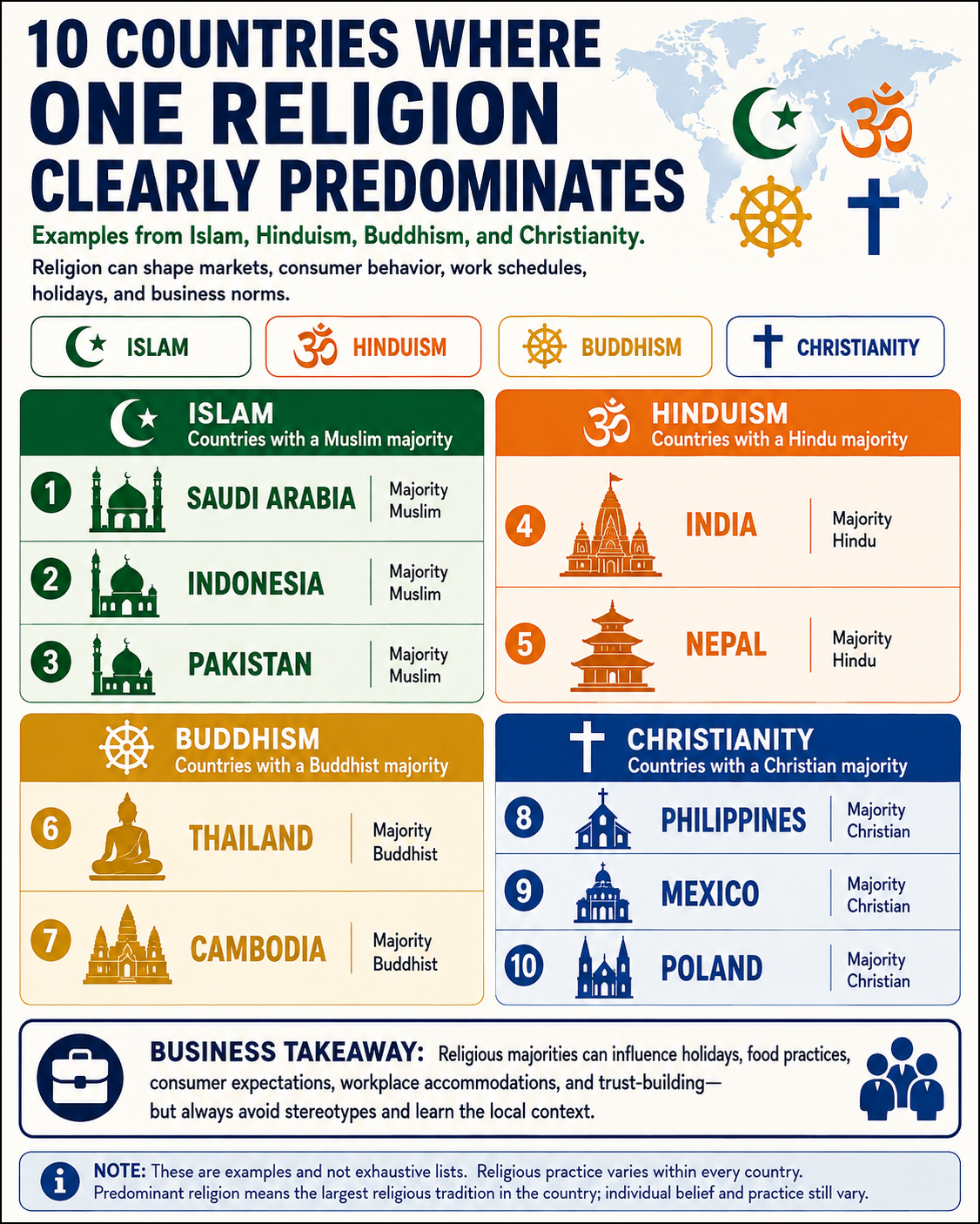
Where One Religion Clearly Predominates

Examples of countries where one of the four faith traditions is predominant, with a reminder to distinguish national patterns from individual belief and practice.

Countries where one religion clearly predominates infographic
Mouse over to enlarge

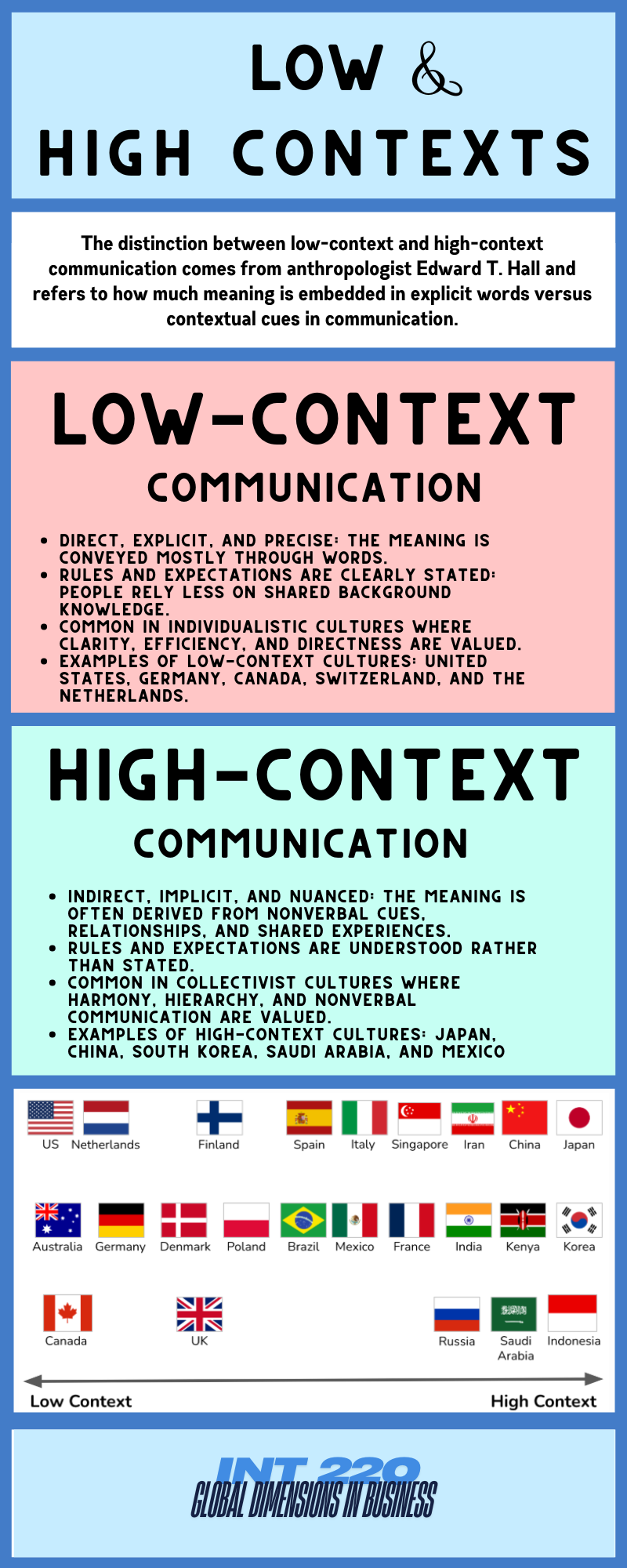
Hall: Low- and High-Context Communication

Review Edward T. Hall's distinction between communication that depends primarily on explicit words and communication that depends more heavily on contextual cues.

Low- and high-context communication infographic
Mouse over to enlarge

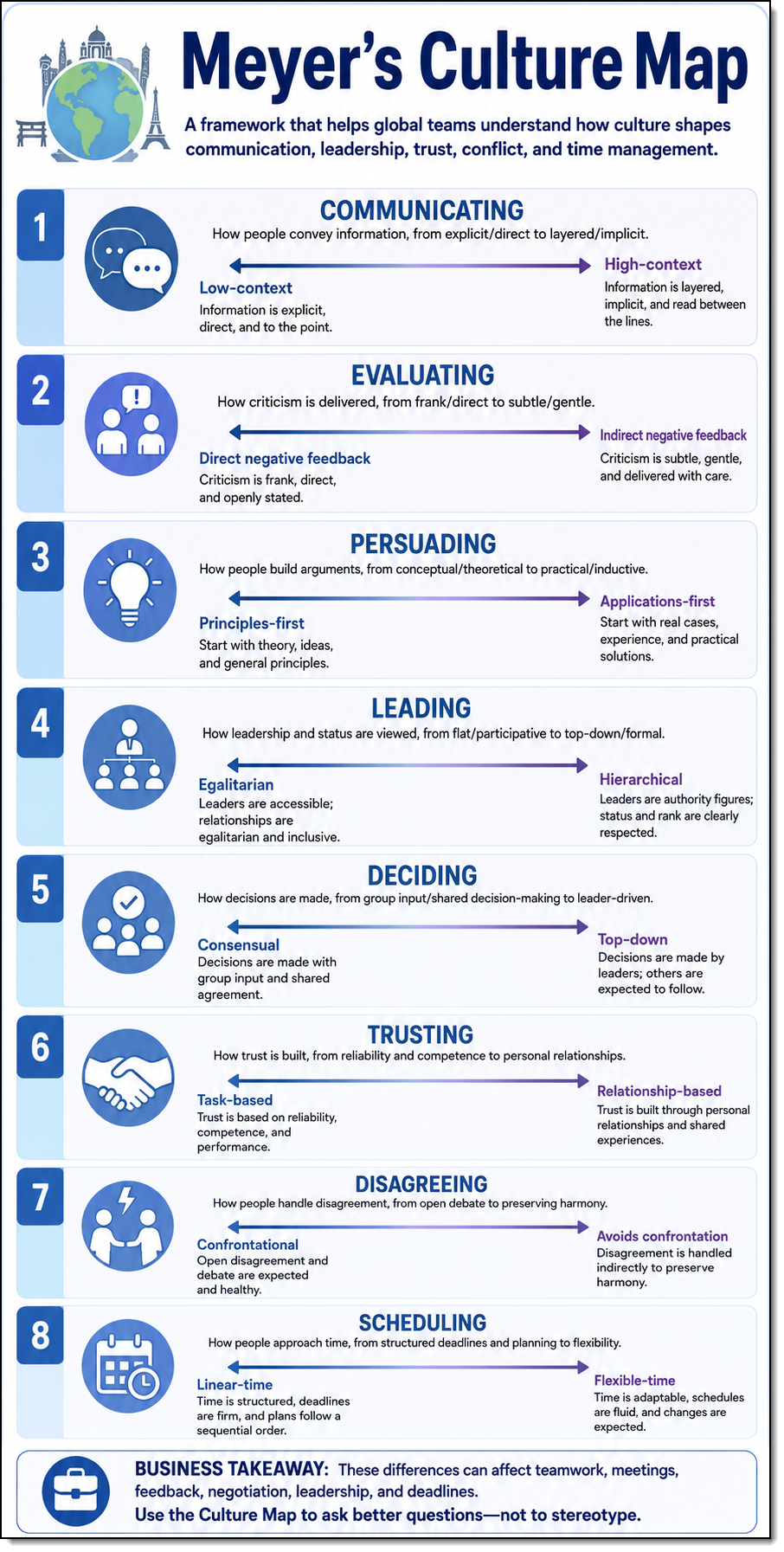
Meyer's Culture Map

Preview the eight dimensions used in the Week 5 Knowledge Check: communicating, evaluating, persuading, leading, deciding, trusting, disagreeing, and scheduling.

Meyer's Culture Map infographic
Mouse over to enlarge
Week 5 Glossary

Culture concepts carried forward from Week 4

Week 5 is a continuation of the culture unit. Keep these core culture concepts available as you work with faith, communication context, and the Culture Map.

Culture

The collection of values, beliefs, behaviors, customs, and attitudes that distinguish a society.

Social Structure

The overall framework that determines the roles of individuals within a society, the stratification of a society, and individuals’ mobility within a society.

Social Stratification

The categorizing of people on the basis of their birth, occupation, educational achievements, and/or other attributes.

Social Mobility

The ability of individuals to move from one stratum of society to another.

Values

The principles and standards accepted by members of a society.

Attitudes

The actions, feelings, and thoughts that result from those values.

Low-Context Culture

A culture in which communication is explicit and direct.

High-Context Culture

A culture in which communication relies heavily on implicit cues and nonverbal signals.

Cultural Cluster

A group of countries that share many cultural similarities.

Individualism

The cultural belief that the person comes first.

Collectivism

The belief that the group comes first.

Power Respect

The acceptance of the power and authority of superiors based on their position in the hierarchy.

Power Tolerance

Less significance attached to a person’s position in the hierarchy.

Uncertainty Acceptance

The feeling that people have regarding uncertain and ambiguous situations that are stimulating and offer opportunities.

Uncertainty Avoidance

Disliking and avoiding ambiguity.

Aggressive Goal Behavior

Placing a high premium on material possessions, money, and assertiveness.

Passive Goal Behavior

Placing a higher value on social relationships, quality of life, and concern for others.

Long-Term Orientation

A focus on the future and perseverance.

Short-Term Orientation

A focus on the past and present and immediate gratification.

Indulgence

A cultural orientation that values leisure time, pleasure, and optimism.

Restraint

A cultural orientation that emphasizes self-control and regulating the actions of cultural members.

Cultural Convergence

The growing similarity of cultures as a result of improvements in communication and transportation.

Self-Reference Criterion

The unconscious use of one’s own culture to assess new surroundings.

Cross-Cultural Literacy

Understanding and adapting to cultural differences.

Week 5 Knowledge Check

Meyer's Culture Map

Can you turn a cultural difference into a better managerial decision?

This Knowledge Check focuses on Meyer's eight dimensions: communicating, evaluating, persuading, leading, deciding, trusting, disagreeing, and scheduling. Each question places one of those dimensions inside a short business scenario and asks you to select the strongest adaptation.

10 questions from a 20-question pool. You will receive one randomly selected question from each of the eight dimensions plus two additional random questions.
What to expect

Four possible responses per scenario, immediate explanatory feedback, and a final score recorded for your instructor.

Use the framework carefully

The Culture Map should help you ask better questions and adapt—not stereotype individuals or entire countries.

Looking ahead: Week 6 shifts from interpreting cultural difference to evaluating business conduct. You will ask what a business should do when competing values, stakeholder interests, and ethical obligations collide.