How much meaning is in the words?
Hall's high- and low-context distinction asks where communicators expect meaning to reside. In a low-context interaction, more of the message is made explicit in the words themselves. In a high-context interaction, more meaning may depend on relationships, shared understanding, status, tone, silence, timing, or other contextual cues.
Low context
Direct, explicit, precise communication. Rules and expectations are more likely to be stated rather than assumed.
High context
Indirect or layered communication. Listeners may need to interpret cues, relationships, shared experience, and what is left unsaid.
Use the framework as a lens, not a label. Countries contain enormous variation. The point is to recognize possible communication expectations and then verify what your actual counterpart needs.
In every scenario, something has already gone wrong. The business relationship, decision, or implementation has suffered. Your job is to diagnose how a context mismatch may have contributed and then choose the strongest repair.
Your completion is recorded only after you finish all six scenarios. The score is formative and is not used as the completion requirement.
Connecting to the completion recorder…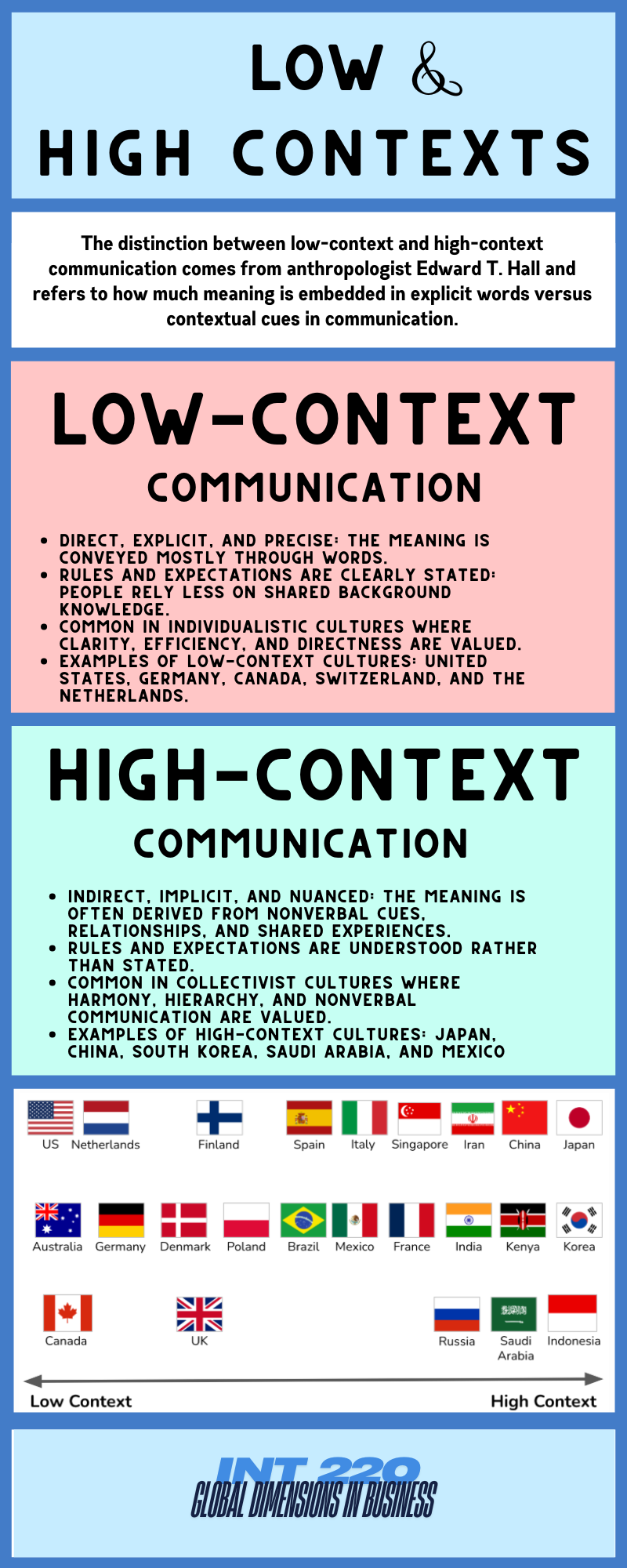
Mouse over the infographic to enlarge it.