Week 1 Focus

Week 1 Focus

This week begins with a practical question: why should a business student care about international business? Rather than beginning with a definition, you will examine the international relationships embedded in an everyday product and then apply the same evidence-first thinking to a major global event.

75 min • in person~75 min • asynchronousResponsible AI useEvidence + judgment

Global in 180

In Person • Rapid applied introduction

Global in 180 merges the former Why Study IB? and IB & You activities into one fast investigation. You will receive a familiar product and uncover the international business system hiding behind it.

The activity introduces the importance of IB by connecting an everyday product to locations, business roles, performance indicators, trends, and a current managerial decision. Your final task is to infer why businesses need international-business knowledge.

Six slides. Thirty seconds each.

  1. Slide 1The Product: show the assigned product and open the global story.
  2. Slide 2Where in the World? identify meaningful countries or regions and their business roles.
  3. Slide 3Why There? explain why one location makes business sense.
  4. Slide 4The Numbers: report a verified indicator of scale or success and its YoY trend.
  5. Slide 5The Manager's Decision: recommend how to build on momentum or reverse decline.
  6. Slide 6Why Businesses Need IB: complete “Businesses need IB because…” using your evidence.
AI rule: use AI to explore, generate leads, and ask better questions—not to paste finished answers. Verify important claims and numbers outside AI. Your recommendation must be your judgment.
Open your assigned Google Slides deck

What’s the GOOOAAAAALLLLL?

Asynchronous • Individual revenue audit

Next, you will move from one product to one revenue stream connected to the 2026 FIFA World Cup. This is a solo HTML-based research audit.

You will select one stream, use generative AI as a research assistant, verify the important claims with credible sources, and compare what was projected before the tournament with what was reported afterward.

Your workflow

  1. ChooseSelect broadcasting, sponsorship, ticketing/hospitality, licensing/merchandise/gaming, digital, or host-city/local-business revenue.
  2. ExploreUse AI to generate leads, possible figures, organizations, and explanations.
  3. VerifyOpen credible sources and confirm every important number or claim.
  4. AuditComplete the projection, reported outcome, comparison, explanation, verdict, IB takeaway, and AI-accountability sections.
  5. SubmitDownload the Word-readable report and upload it manually to the Week 1 Brightspace assignment.
How the pieces connect

From product to market evidence

Global in 180 shows that a familiar product becomes an international-business problem as soon as you follow its locations, markets, numbers, and managerial choices. What’s the GOOOAAAAALLLLL? then asks you to apply the same logic independently: identify a global business stream, verify evidence, interpret performance, and make a defensible judgment.

Week 1 Resources

See it, hear it, and keep the key ideas close.

Begin with the video. Hover over either infographic to enlarge it; click to open a large static view.

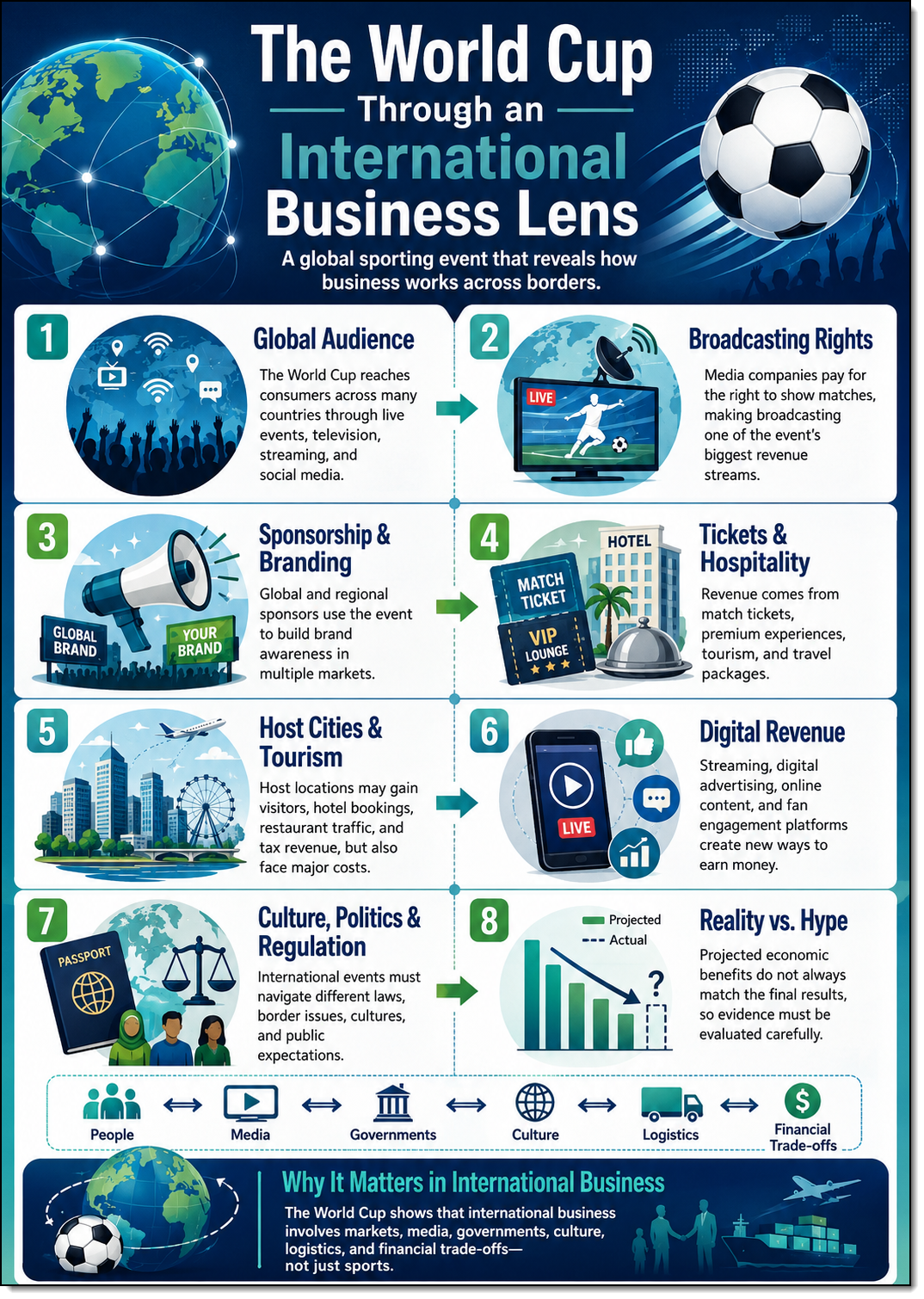
The World Cup Through an IB Lens

Use the short video to see how international business becomes visible through media, sponsors, tourism, logistics, regulation, and revenue.

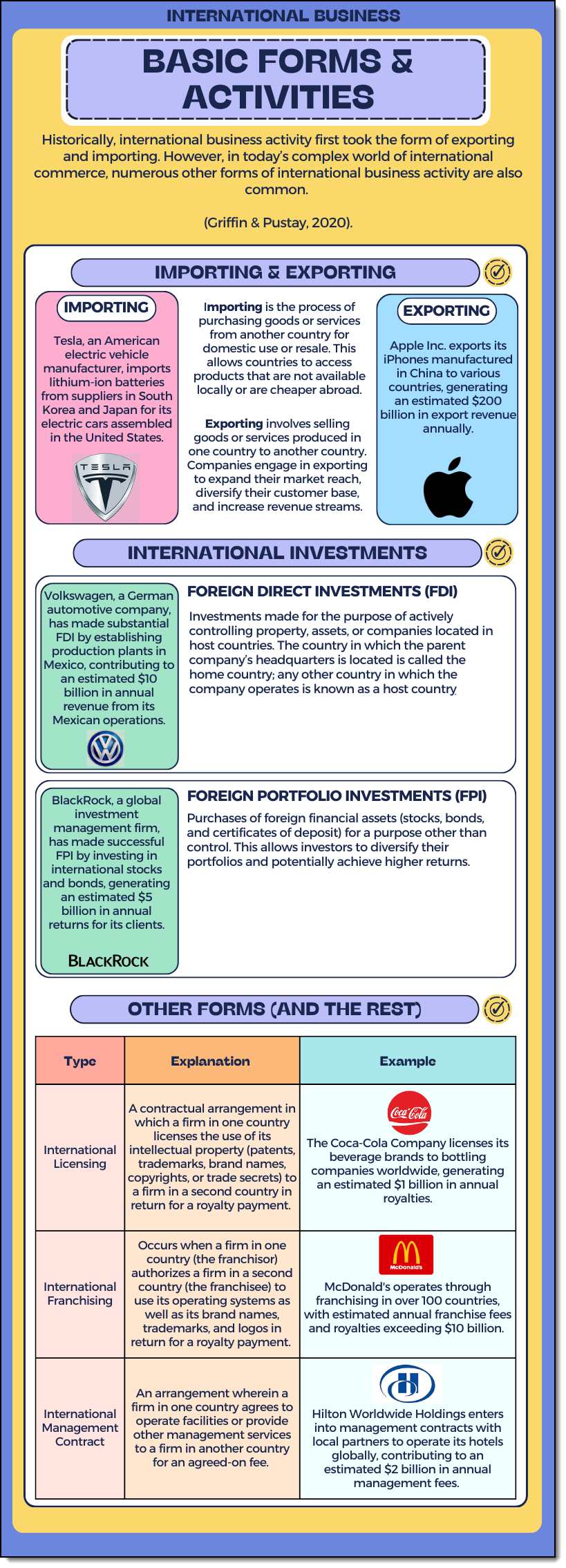
Basic Forms & Activities

Use this visual as a quick reference for the basic ways firms participate in international business.

International Business Basic Forms and Activities infographic covering importing, exporting, FDI, portfolio investment, licensing, franchising, and management contracts
Hover to enlarge • click for large view

International Business Through the World Cup

Use this infographic to connect the Week 1 concepts to a global event involving cross-border markets, firms, and revenue.

The World Cup Through an International Business Lens infographic
Hover to enlarge • click for large view
Deep Dive: Why Study IB? podcast thumbnail
Listen

Deep Dive: Why Study IB?

Prefer to listen? Revisit why international business matters to firms, careers, markets, and the decisions managers make across borders.

Listen to the Deep Dive
Week 1 Glossary

Key terms for international business

Use this glossary as a quick reference while working through Week 1 and when reviewing for the Knowledge Check.

Exporting

Selling products made in one's own country for use or resale in other countries.

Importing

Buying products made in other countries for use or resale in one's own country.

Multinational Corporation (MNC)

A company that has operating facilities or assets in more than one country.

Merchandise Exports/Imports

Trade in goods (tangible products), also known as visible trade.

Service Exports/Imports

Trade in intangible products, also known as invisible trade.

Foreign Direct Investment (FDI)

Investments made for the purpose of actively controlling property, assets, or companies located in foreign host countries.

Home Country

The country from which the investment flows in FDI.

Host Country

The country to which the investment flows in FDI.

Portfolio Investment

Purchases of foreign financial assets (stocks, bonds, certificates of deposit) for purposes other than control.

Licensing Agreement

An agreement allowing a firm in one country to use the intellectual property of a firm in a second country in exchange for a royalty payment.

Franchising Agreement

An agreement allowing a firm in one country to use the brand names, logos, and operating techniques of a firm in a second country in exchange for a royalty payment.

Management Contract

An agreement in which a firm in one country agrees to operate facilities or provide other management services for an agreed-upon fee.

Globalization

The inexorable integration of markets, nation-states, and technologies that enables individuals, corporations, and nation-states to reach around the world farther, faster, deeper, and cheaper than ever before.

Core Competencies

Unique skills or advantages that enable a company to compete successfully.

Emerging Markets

Markets beyond North America, Western Europe, and Japan experiencing rapid economic growth.

Trade Barriers

Government-imposed restrictions on the free international exchange of goods or services.

Cultural Literacy

The ability to understand and function effectively in different cultures.

Week 1 Knowledge Check

Before moving on to Week 2, check your understanding.

This short individual check asks you to connect the ideas from both this week’s in-person and asynchronous work to the core concepts of international business.

Complete this last: Use the knowledge check after you have finished the Week 1 activities and reviewed the resources and glossary above.
Looking ahead: Week 2 moves from why IB matters to a new question: where are the opportunities, and how do we compare markets?