Putting ideas into practice • Case analysis and student-led learning.
This week’s focus
When a global strategy meets local competition, what should change?
Praxis means putting ideas into practice. This week brings together strategy formulation, international implementation, strategic partnerships, organizational structure, and control systems from Weeks 8–10. Our case asks why Amazon struggled to gain traction in China despite its global strengths, and what Elaine Chang could have done to improve its competitive position. In our first session, we evaluate strategic choices. In our second session, students lead the learning.
Amazon in China: Case Overview
Listen to the case overview before our discussion.
Session 1 / Case study
Investigate the strategic dilemma
Consider how Amazon entered China, the adjustments it made, the domestic competitors it faced, and the strategic alternatives available to Elaine Chang.
Choose a focused idea from Weeks 8–10: strategy formulation, implementation, alliances, organizational structure, or control systems. Help classmates apply it in no more than 10 minutes.
Amazon.com in China: Can Elaine Chang Crack the Chinese Market?
Amazon entered China in 2004 through its acquisition of Joyo.com. By 2017, however, its share of Chinese e-commerce remained below 3%, despite efforts to localize its website, improve delivery, introduce Prime, and participate in Alibaba’s Tmall marketplace. Domestic competitors including Alibaba and JD.com were better positioned in several areas, while regulations, online payment preferences, counterfeit products, and demanding logistics complicated Amazon’s growth.
Put yourself in Elaine Chang’s position. Should Amazon continue pursuing broad competition in domestic e-commerce, differentiate around authentic international goods and cross-border shopping, rely more heavily on local partners, or redesign its operating model? Evaluate these as choices facing management at the time of the case, not with the benefit of later outcomes.
Assigned case: Amazon.com in China: Can Elaine Chang Crack the Chinese Market? The supporting teaching note is an instructor resource; consult the assigned case text for your analysis.
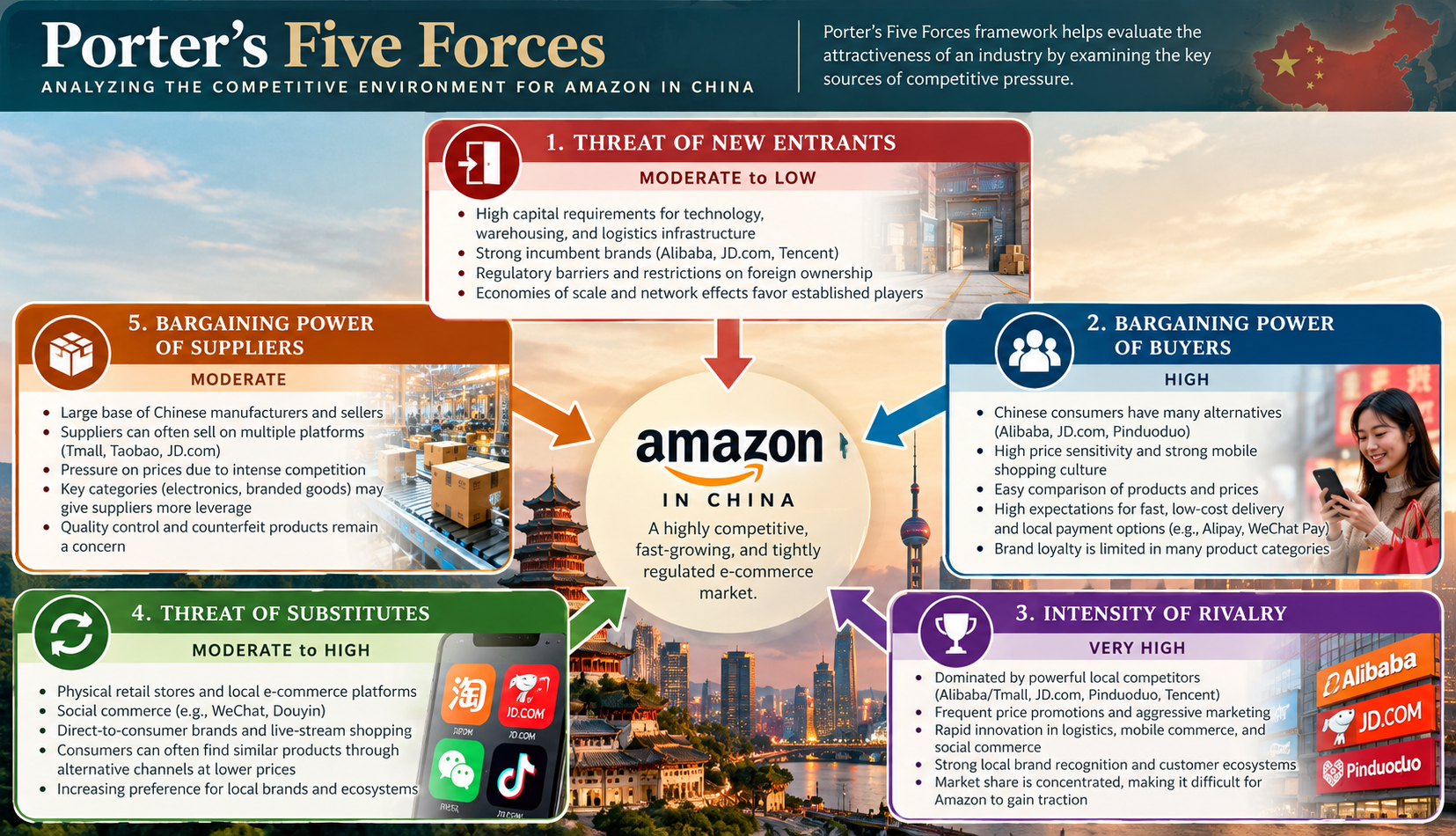
Porter’s Five Forces: Amazon in China
Use the five forces to examine competitive pressure around Amazon at the time of the case.
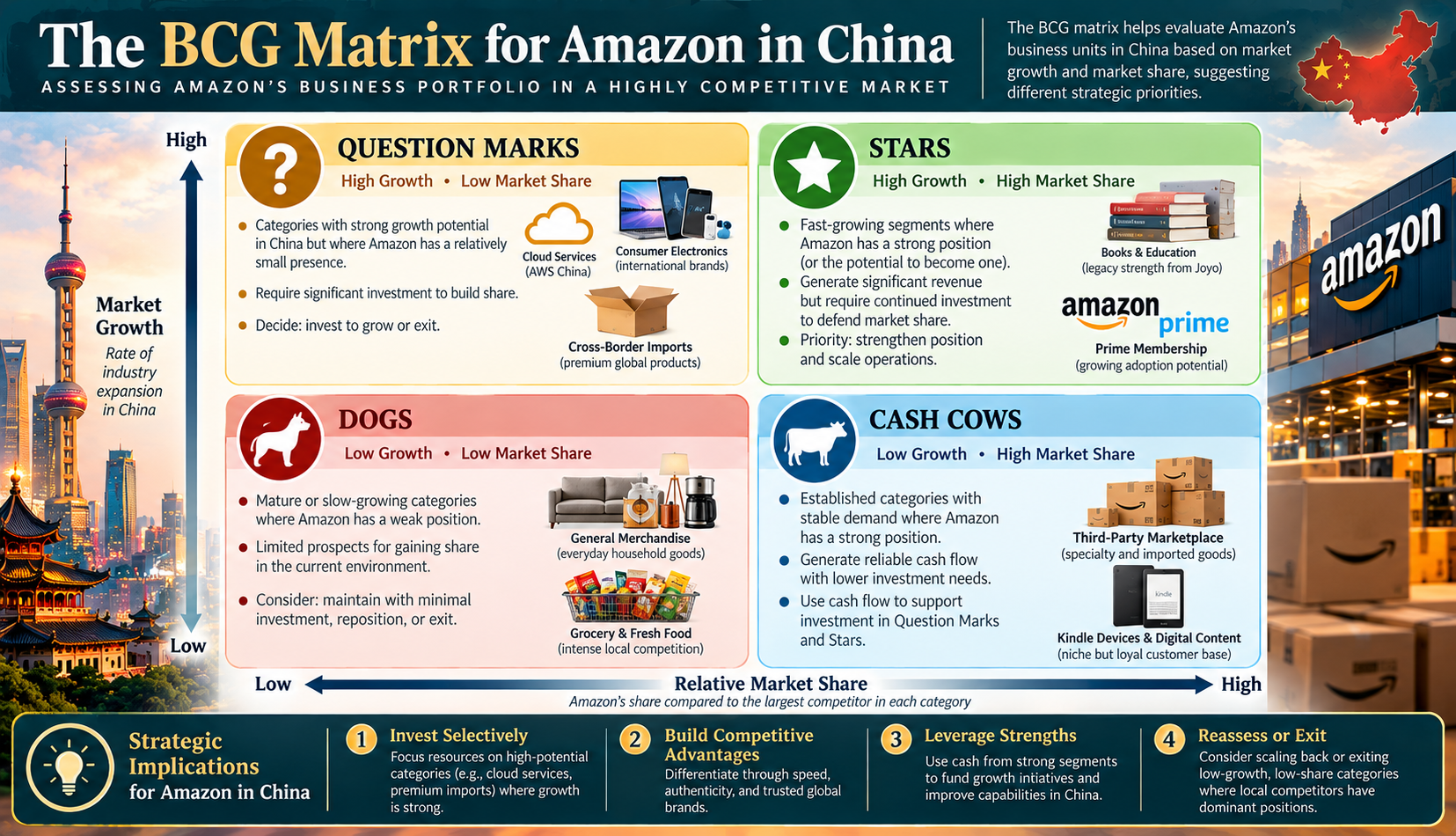
The BCG Matrix: Amazon in China
Use the matrix to discuss how management might prioritize businesses. The illustrative classifications are discussion prompts, not verified portfolio market-share measurements.
Keep this question in view: Was Amazon’s main problem the strategy it chose, the way it implemented that strategy, or the organizational arrangements supporting it? Defend your answer with evidence.
Amazon in China • Case Overview Video
Historical case materials describe Amazon's competitive position around 2017; distinguish that period from present-day market conditions.
Session 1 / Case analysis
Apply the case-analysis framework
Use the same three-part framework introduced in earlier Praxis weeks. Connect evidence from the assigned Amazon case to strategic formulation (Week 8), implementation and alliances (Week 9), and organizational structure and control (Week 10).
Here is what I am looking for: Identify the problem clearly; explain what Amazon actually did; then develop a supported judgment about whether those actions addressed the key obstacles. Distinguish decisions, outcomes, and proposals.
Keep the foundation concise: Sections 1 and 2 combined should not exceed one page. Section 3 is the most important section and should receive the greatest attention. Consult Brightspace for submission requirements.
Section 1
1. Identify the Central Issue
What this section does: Define Amazon’s core strategic dilemma rather than simply listing every obstacle. Establish what was at stake for Elaine Chang and for the company’s China operations.
A useful starting question: Why was Amazon struggling to convert an attractive market opportunity into a strong competitive position?
Sample response · Identify the Central Issue
Amazon’s central issue was its weak competitive position in Chinese e-commerce despite more than a decade of investment. Its acquisition of Joyo provided entry to a rapidly growing market, but local competitors better matched customer preferences in pricing, payments, shopping experience, and delivery. Amazon had to decide whether to adapt more deeply, choose a narrower segment, or change how it operated with local firms.
Notice the move: This statement prioritizes a strategic decision and uses market-share evidence without mistaking all symptoms for separate central issues.
Section 2
2. Examine the Company’s Response
What this section does: Describe Amazon’s entry and localization actions, then connect them to relevant international management concepts. Do not evaluate their success yet.
A useful starting question: Which decisions illustrate Amazon’s approach to market entry, localization, partnerships, and implementation?
Sample response · Examine the Company’s Response
Amazon entered through acquisition of Joyo.com in 2004 and subsequently broadened its offerings. It introduced local web-domain and shopping adaptations, doorstep card-payment capability, Prime-related delivery benefits, and a storefront on Tmall. These actions show attempts to adapt a global business model while leveraging existing capabilities. They also reveal implementation choices involving technology, distribution, and collaboration with a dominant local platform.
Notice the move: Actions and intended purposes are reported separately from conclusions about effectiveness.
Section 3
3. Evaluate the Response
What this section does: Judge the effectiveness of Amazon’s actions, weighing competing explanations and developing a defensible strategic path. Use evidence from the case and concepts from Weeks 8–10.
A useful starting question: Should Elaine Chang have emphasized broader localization, differentiated cross-border offerings, new partnerships, or a different operating structure—and why?
Sample response · Evaluate the Response
Amazon’s efforts demonstrated responsiveness, but the limited share it held by 2017 suggests the changes had not produced a strong domestic competitive position. Acquisition gave it an established foothold, and localized website and payment initiatives addressed some practical barriers. Yet domestic rivals had powerful advantages in pricing, payments, logistics, and familiarity with Chinese shopping behavior. Offering features similar to competitors did not necessarily produce differentiation.
The more compelling option at the decision point may have been a narrower strategy built around authentic imported products and cross-border shopping, where Amazon’s international sourcing and fulfillment network could create a distinct advantage. A more deliberate partnership approach could complement that choice, although dependence on a rival platform such as Tmall would introduce control and bargaining-power concerns.
Implementation also matters. Elaine would need clear accountability for local customer insight, authority to make timely adaptations, suitable metrics beyond website traffic, and coordination between headquarters and Chinese operations. These are recommendations, not evidence that Amazon already made those changes. The case does not establish that any single alternative would succeed; an effective evaluation compares risks, investment requirements, and measurable outcomes for the options.
Notice the move: This evaluation acknowledges strengths, tests outcomes against the problem, and treats alternative strategic choices as proposals rather than settled facts.
Using case evidence
Use author–date citations from the assigned case material and identify the relevant page or section when appropriate. The 2018 ICMR teaching note provides the historical framing used here; it is not a substitute for citing your assigned case. Support interpretations with specific case incidents and distinguish contemporaneous facts from any later research.
Instructor reference: IBS Center for Management Research. (2018). Amazon.com in China: Can Elaine Chang crack the Chinese market? [Teaching note, BSTR/541].
Session 2 / Student-led learning
Your turn to lead
Create a short learning session that helps classmates apply a specific concept from Weeks 8–10. Explain the idea, offer a management decision or dilemma, and show why it matters to multinational organizations.
Time limit: no more than 10 minutes total. Include any video, activity, and class discussion within that limit. Choose a scope you can teach clearly in the time available.
Choose your delivery mode
You may use PowerPoint, an infographic, or video. Other suitable approaches include a short live demonstration, a role-play, a guided discussion built around a visual, or an interactive poll or mini-scenario. You may combine formats when doing so supports the learning. Whatever format you choose, use it to guide a coherent session and make your explanation and analysis clear.
Five possible topics
The Strategy That Travels—and the One That Doesn’t Why might a strategy that succeeds at home fail abroad? Compare standardization with local responsiveness in a foreign market. Invite the class to choose what to retain and what to adapt.
Alliance or Go It Alone? Should a multinational enter or expand through an alliance, acquisition, joint venture, or independent operation? Present a partner-selection dilemma and ask classmates to weigh control, learning, speed, and risk.
A Brilliant Plan, Poor Execution Why do promising international strategies fail during implementation? Give a scenario with competing resource demands and unclear responsibilities. Ask classmates to diagnose whether the problem lies in strategy, implementation, or both.
Who Should Make the Decision? How should authority be divided between headquarters and foreign subsidiaries? Present a local market decision and compare centralized, decentralized, and shared decision-making, including how structure shapes responsiveness.
What Gets Measured Gets Managed? Which control measures best reveal whether an international operation is succeeding? Challenge classmates to design a small dashboard balancing financial results, local customer satisfaction, partner performance, and long-term learning.
Original topics are welcome, but you must obtain my approval before you begin compiling materials for your session. Propose a focused topic and briefly explain its connection to international management.
Give your session a clear shape
Open with a question, example, or dilemma that establishes the focus. Explain the relevant concept in your own words, then use a concrete example to help classmates apply it. Invite a brief response or decision from the class, and close by drawing the learning together into a clear takeaway. This is a flexible sequence; adapt it to your topic and delivery mode.
General guidance for success
Teach one meaningful idea well. A narrow question explored thoughtfully will help the class more than a broad collection of facts. Make the connection to international management explicit.
Explain the significance. Move beyond describing differences or listing concepts. Help classmates understand why the example matters, who is affected, and what it reveals about international management. Treat cultural patterns as a starting point for inquiry rather than assumptions about every individual.
Use evidence thoughtfully. Support factual claims with credible sources and identify them in your slides, infographic, video credits, or accompanying materials. Distinguish a company’s claims from independently supported results and your own interpretation. Use APA author–date citations where appropriate and provide enough source information for classmates to locate the material.
Design for your classmates. Keep text readable, visuals purposeful, and audio understandable. Caption video where possible. Explain unfamiliar terms and give the class enough context to participate.
Make participation purposeful. Ask a focused question or offer a short choice that helps classmates use the idea. Leave room to respond to what they say and connect their contributions to your takeaway.
Rehearse the whole session. Check the timing, media, and transitions. Have a simple backup if a link or video fails. Finish within 10 minutes with a clear statement of what classmates should carry forward.
What I am looking for: A prepared, understandable session that helps your classmates learn and apply something useful. Let your topic, evidence, and explanation guide your choices. The format should support the learning.