Putting ideas into practice • Global human resource management and student-led learning.
This week’s focus
How do you manage the people behind a global performance?
Bring together international human resource management, global careers and teams, motivation, and leadership from Chapters 9–11. Use the Cirque du Soleil case to examine how people practices support an international organization, then lead classmates through a focused management question.
Cirque du Soleil: Case Overview
Listen before our case discussion.
Session 1 / Case study
Examine global people practices
Select two HR topics and investigate Cirque’s practices, responses, and results.
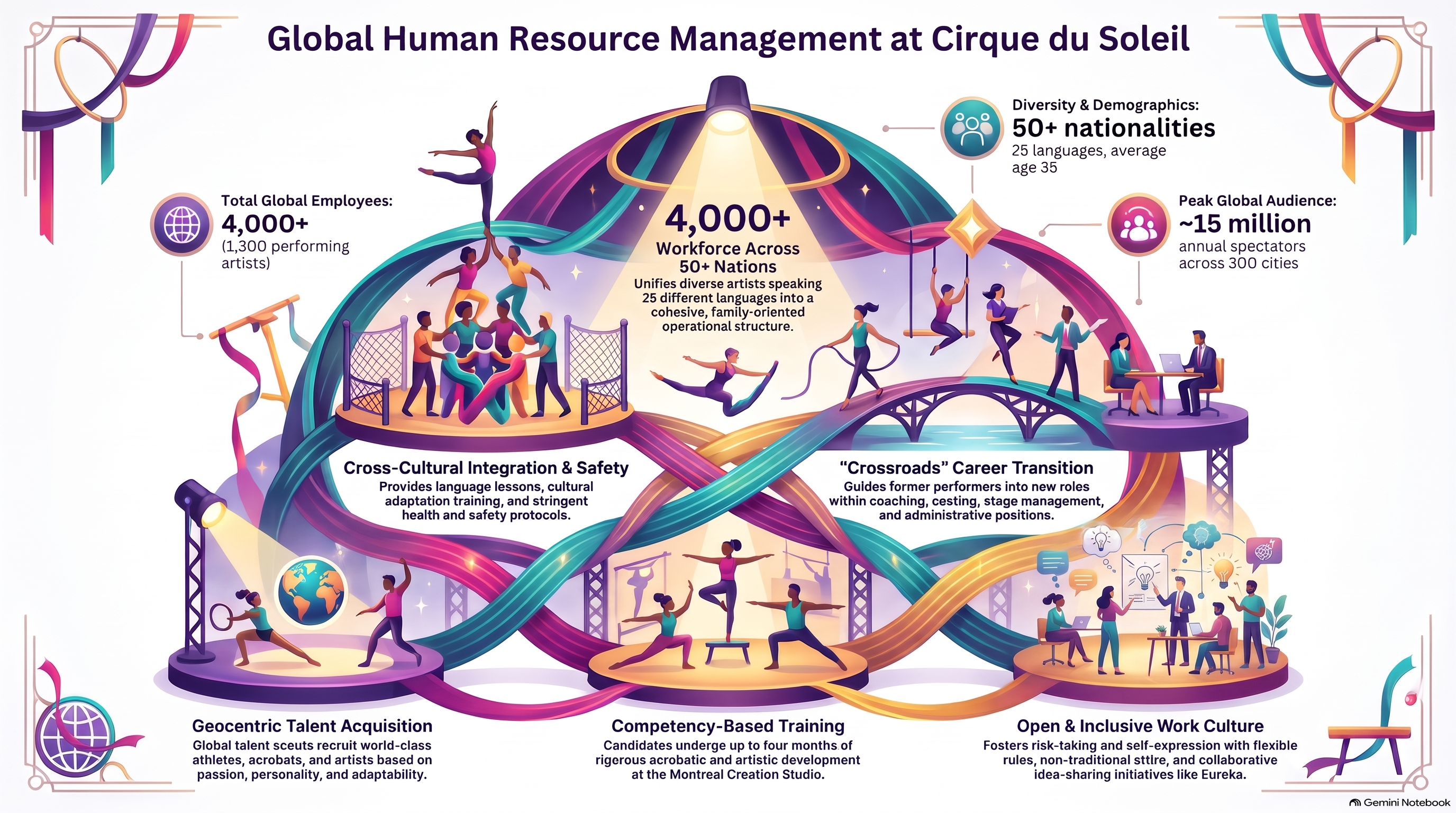
Cirque du Soleil’s Global Human Resource Management Practices
Cirque’s international performances depend on attracting, developing, and supporting people across cultures. This case examines the HR choices behind that work and the challenge of sustaining a creative organization. Focus on two HR topics, investigate what the company did, and judge how well its responses addressed the needs you identify.
Use this overview to frame questions for investigation. Treat its figures as historical context and check claims against the assigned case and dated sources.
Cirque du Soleil • Case Overview Video
Session 1 / Case analysis
Apply the case-analysis framework
Use the same three-part framework as earlier Praxis weeks. Select two topics: recruitment and selection; training and development; compensation and benefits; retention; communication; or career transition. Carry those same two topics through all three sections.
Here is what I am looking for: Define the HR issues, explain how Cirque responded, and evaluate those responses through both theory and practical evidence. Keep your own recommendations distinct from actions the company actually took.
Keep the foundation concise: Sections 1 and 2 combined should not exceed one page. Section 3 is the most important section and should receive the greatest attention. Consult Brightspace for submission requirements.
Section 1
1. Identify the Central Issue
What this section does: Discuss Cirque’s global human resource management practices within your two selected topics. For each, identify a specific challenge or tension, explain why it matters, and connect it to the international context. Move beyond naming the topic or summarizing the company.
A useful starting question: What people-management issue needs attention in each of your two topics, and why does it matter to Cirque’s employees and performance?
Sample response · How to begin
For one selected topic, I would begin: “Within [topic], Cirque faces a tension between [need] and [competing demand]. This matters because [consequence], as illustrated by [specific case evidence].” Then develop the issue in your own words.
Notice the move: This opening names a problem to investigate; it does not choose your topics or supply the analysis. This is a starting scaffold, not a completed response.
Section 2
2. Examine the Company’s Response
What this section does: For each selected topic, explain how Cirque responded. Use the assigned case and external research to identify specific policies, programs, or management actions and their intended purposes. Identify when each action occurred; distinguish historical case practices from later changes.
A useful starting question: What did Cirque actually do in response to each issue, and what evidence establishes the action and its purpose?
Sample response · How to begin
A starting structure is: “To address [issue], Cirque introduced or used [documented practice] ([citation]). Its intended purpose was [purpose]. An external source dated [date] adds [relevant detail].” Verify each detail before building on it.
Notice the move: Report the response with evidence before judging it. An action is not, by itself, proof of success. This is a starting scaffold, not a completed response.
Section 3
3. Evaluate the Response
What this section does: Evaluate the responses for both selected topics. Be theoretical and practical: apply relevant concepts from Chapters 9–11 to explain strengths and weaknesses, then use external research to examine available results. Explain whether evidence supports, qualifies, or challenges your judgment. Consider the quality, date, scope, and limitations of that evidence.
A useful starting question: Why should the response work in theory, what weaknesses might limit it, and what practical results support your position?
Sample response · How to begin
Begin with a judgment you can test: “Viewed through [relevant concept], this response has a potential strength in [reason] but a weakness in [reason]. To assess effectiveness, I would examine [relevant outcome].” Then locate evidence, explain what it shows, and revise or qualify your judgment. If no suitable results are available, state that limitation and propose a measure rather than assuming success.
Notice the move: Connect theory to a reasoned judgment and test it against results. Suggested measures are not observed outcomes. This is a starting scaffold, not a completed response.
Using case evidence and external research
Cite the assigned case and credible external sources using APA author–date citations, with page references where appropriate, and provide a reference list. Identify the period each source describes. Separate company statements, independently supported outcomes, and your own interpretations. A later result may inform your evaluation, but explain its connection to the earlier practice and avoid assuming that one practice caused the result.
Session 2 / Student-led learning
Your turn to lead
Create a short learning session that helps classmates apply a specific concept from Chapters 9–11. Explain the idea, offer a management decision or dilemma, and show why it matters to multinational organizations.
Time limit: no more than 10 minutes total. Include any video, activity, and class discussion within that limit. Choose a scope you can teach clearly in the time available.
Choose your delivery mode
You may use PowerPoint, an infographic, or video. Other suitable approaches include a short live demonstration, a role-play, a guided discussion built around a visual, or an interactive poll or mini-scenario. You may combine formats when doing so supports the learning. Whatever format you choose, use it to guide a coherent session and make your explanation and analysis clear.
Five possible topics
Who Gets the International Assignment? Compare expatriate, host-country, and third-country staffing (Chapter 9). Give classmates a staffing dilemma and ask them to weigh competence, cultural preparation, local knowledge, and development needs.
Ready to Work Abroad? Explore expatriate preparation and adjustment (Chapter 9). Ask classmates to design a focused preparation plan that addresses work, daily life, and family needs, then explain how they would judge its effectiveness.
Coming Home Is Another Transition Examine repatriation and career management (Chapter 10). Present a returning employee whose international experience is underused. Ask classmates to propose a return plan that benefits both the employee and the organization.
One Team, Several Cultures Examine global management teams (Chapter 10). Give classmates a disagreement involving communication, participation, or coordination. Help them design team practices that make room for different perspectives without stereotyping individuals.
Would This Leadership Approach Travel? Connect motivation and culturally contingent leadership (Chapter 11). Present a manager using the same rewards and leadership approach in different locations. Ask classmates what evidence they would gather and what they might adapt.
Original topics are welcome, but you must obtain my approval before you begin compiling materials for your session. Propose a focused topic and briefly explain its connection to international management.
Give your session a clear shape
Open with a question, example, or dilemma that establishes the focus. Explain the relevant concept in your own words, then use a concrete example to help classmates apply it. Invite a brief response or decision from the class, and close by drawing the learning together into a clear takeaway. This is a flexible sequence; adapt it to your topic and delivery mode.
General guidance for success
Teach one meaningful idea well. A narrow question explored thoughtfully will help the class more than a broad collection of facts. Make the connection to international management explicit.
Explain the significance. Move beyond describing differences or listing concepts. Help classmates understand why the example matters, who is affected, and what it reveals about international management. Treat cultural patterns as a starting point for inquiry rather than assumptions about every individual.
Use evidence thoughtfully. Support factual claims with credible sources and identify them in your slides, infographic, video credits, or accompanying materials. Distinguish a company’s claims from independently supported results and your own interpretation. Use APA author–date citations where appropriate and provide enough source information for classmates to locate the material.
Design for your classmates. Keep text readable, visuals purposeful, and audio understandable. Caption video where possible. Explain unfamiliar terms and give the class enough context to participate.
Make participation purposeful. Ask a focused question or offer a short choice that helps classmates use the idea. Leave room to respond to what they say and connect their contributions to your takeaway.
Rehearse the whole session. Check the timing, media, and transitions. Have a simple backup if a link or video fails. Finish within 10 minutes with a clear statement of what classmates should carry forward.
What I am looking for: A prepared, understandable session that helps your classmates learn and apply something useful. Let your topic, evidence, and explanation guide your choices. The format should support the learning.