Putting ideas into practice • Case analysis and student-led learning.
This week’s focus
What turns cultural diversity into meaningful inclusion?
Praxis means putting ideas into practice. This week brings our work on culture, cross-cultural communication, negotiation, and decision-making into a management dilemma. In our first session, we examine a Singaporean project manager’s experience at a cybersecurity firm in Zurich. In our second session, students lead the learning.
Cross-Cultural Challenges: Case Overview
Listen to the case overview as you prepare for our discussion.
Session 1 / Case study
Investigate the dilemma
Read the assigned case and consider how managers can support international employees, bridge communication gaps, and evaluate whether inclusion initiatives create a sense of belonging.
Our second session shifts the lead to students. Choose a focused topic from Weeks 4–6 and help classmates apply ideas about culture, communication, negotiation, or decision-making in no more than 10 minutes.
Cross-Cultural Challenges for a Singaporean Expatriate in Zurich
Eunice Lee accepts a project management role at Cybot in Zurich, bringing cybersecurity expertise and experience working with international teams. The company offers professional opportunity and several diversity and inclusion initiatives. Yet after three months, Eunice struggles to build friendships and feel at home.
As you read, examine the interaction among cultural expectations, communication, organizational practices, and individual preferences. The opening cyberattack establishes the business setting; our analysis focuses on cross-cultural adjustment and workplace inclusion. Avoid assuming that nationality explains every behavior.
Read Case 3 in your course text: Cross-Cultural Challenges for a Singaporean Expatriate in Zurich, by Christina Neylan.
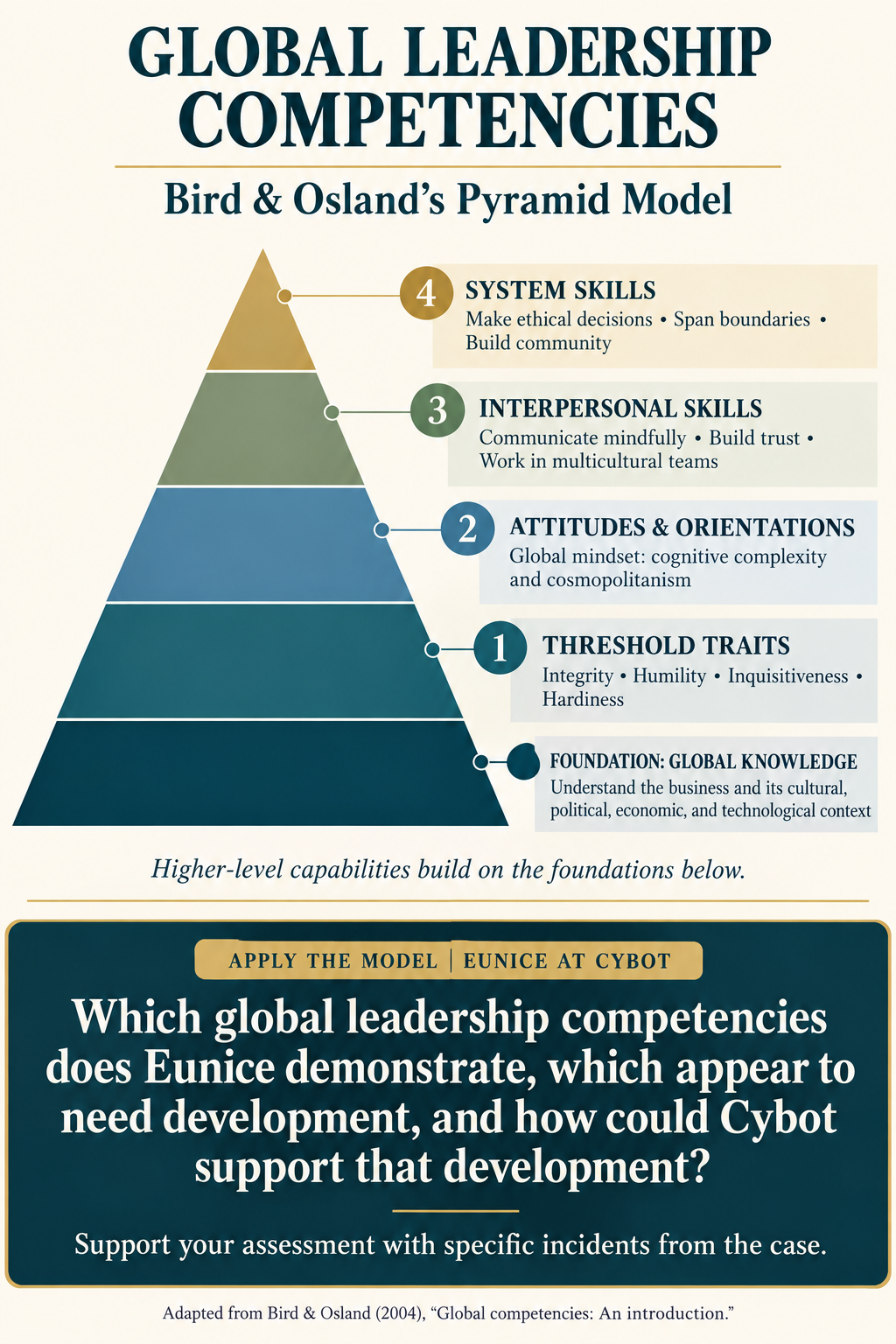
Bird and Osland’s global leadership competencies provide one lens for examining the case. Consider the capabilities of Eunice, her managers, and her coworkers.
Keep this question in view: Which global leadership competencies does Eunice demonstrate, which appear to need development, and how could Cybot support that development? Support your assessment with specific incidents from the case.
Case Overview Video
Case author: Christina Neylan, Lucerne University of Applied Sciences and Arts. The case presents a fictional management situation for analysis.
Session 1 / Case analysis
Apply the case-analysis framework
Use the same three-part framework introduced in Week 3 to analyze Cybot’s approach to cross-cultural adjustment and workplace inclusion. Connect your assessment to relevant ideas from Weeks 4–6. The original questions in the case can inform your thinking; organize your analysis using the three sections below.
A useful case analysis has three connected parts: identify the central issue, examine the company’s response, and evaluate that response. Read the guidance first, consider your own interpretation, and then open each sample response.
Here is what I am looking for: Help me follow your thinking. Establish what happened, explain how the company responded, and then develop a supported judgment about how well its response addressed the issue. Use course concepts and specific case evidence. Distinguish commitments and activities from demonstrated results, acknowledge limitations in the evidence, and explain why your assessment is reasonable.
Keep the foundation concise: Sections 1 and 2 combined should not exceed one page. They provide the foundation for your evaluation. Section 3 is the most important section and should receive the greatest attention and development. Follow the assignment instructions in Brightspace for submission details.
Section 1
1. Identify the Central Issue
What this section does: Establishes what happened and why it mattered. Focus on the central ethical or management issue rather than retelling the entire case.
What you could include: A concise statement of the management problem, the stakeholders affected, and selected incidents showing its significance. Distinguish what characters do from how Eunice interprets their behavior.
A useful starting question: What happened, who was affected, and why did it matter?
Sample response · Identify the Central Issue
The central issue is the gap between Cybot’s efforts to include international employees and Eunice’s experience of isolation. Despite a promising role and opportunities to meet colleagues, she reports having made no friends after three months. At one networking event, colleagues switch to Swiss German after initial introductions, limiting her participation (Neylan, n.d., Sections 2–3). Her experience raises a management question: how can Cybot help international employees participate and build relationships while recognizing that culture, individual expectations, and personal preferences all shape adjustment?
Notice the move: The response identifies a focused management problem using selected evidence and leaves the evaluation for Section 3.
Section 2
2. Examine the Company’s Response
What this section does: Explains what the company actually did and connects those actions to relevant course concepts. Describe the response before judging its effectiveness.
What you could include: Cybot’s principal support and inclusion practices, their intended purposes, and connections to culture, perception, communication, or global leadership competencies. Here, response includes existing practices; the case does not establish that management knew the full extent of Eunice’s distress.
A useful starting question: How did the company respond, and what was it trying to accomplish?
Sample response · Examine the Company’s Response
Cybot provides relocation support and introduces Eunice to a range of diversity and inclusion activities, including informal lunches, mentoring, networking, sports, and cultural evenings. Sarah explains these opportunities during Eunice’s first week, while Andreas advises her to learn German (Neylan, n.d., Sections 1 and 3). These practices are intended to help newcomers form connections and adjust. They relate to cross-cultural communication and relationship building because they create opportunities for interaction, although offering opportunities does not establish that employees can participate meaningfully.
Notice the move: The response describes what the company offers and its intended purpose, while acknowledging what the case does not establish.
Section 3
3. Evaluate the Response
What this section does: Develops your judgment about how effectively the company addressed the central issue. This is the most important section: explain why the evidence supports your assessment.
What you could include: Strengths and shortcomings, evidence of results, stakeholder effects, and limitations in what the case establishes. Distinguish promises, actions, and outcomes. Consider the company’s constraints without treating them as an excuse. Improvements may follow from your evaluation, but a separate recommendation section is not required.
A useful starting question: How well did the response address the issue, and what evidence supports your judgment?
Sample response · Evaluate the Response
Cybot’s approach shows a meaningful commitment to welcoming newcomers, but its effectiveness appears uneven in Eunice’s experience. HR offers several routes to connection rather than leaving her entirely on her own. Colleagues also invite her to activities and praise her contribution to the cultural evening (Neylan, n.d., Sections 3–5). These details matter because her isolation should not be treated as proof that everyone rejects her or that every company initiative has failed.
However, access to an activity is different from meaningful participation. When networking conversations shift into Swiss German, Eunice loses an opportunity to engage. Several popular activities also do not match her interests, while the hiking trip becomes difficult because she lacks suitable shoes (Neylan, n.d., Section 3). My assessment is that Cybot provides opportunities without consistently checking whether newcomers can use them effectively. The case does not establish what mentoring support she actually received, so it would be premature to declare that program ineffective.
The cultural evening also reveals a communication gap. Eunice prepares an elaborate meal and interprets the brief gathering and her colleagues’ use of utensils differently from what their compliments might suggest (Neylan, n.d., Sections 4–5). Applying cognitive complexity, I would consider several explanations for their behavior rather than assume disrespect. Likewise, her decision to decline some invitations reflects personal preferences that managers should explore rather than automatically attribute to nationality.
Overall, I would judge Cybot’s approach as constructive but insufficiently responsive to this employee’s experience. A manager could hold a private check-in, clarify expectations, and agree with Eunice on practical support. The team could adopt inclusive language practices for shared work discussions and offer varied ways to connect. Eunice could also ask for clarification and identify activities and language-learning options she finds workable. These are proposed improvements, not actions reported in the case. A stronger evaluation of outcomes would require follow-up evidence about participation, working relationships, and Eunice’s sense of belonging. Her distress warrants attention, but the case does not establish a final assignment outcome or justify concluding that she lacks the capacity to succeed abroad.
Notice the move: The response weighs strengths and shortcomings, considers alternative explanations, and distinguishes proposed improvements from reported actions.
Using case evidence
The examples paraphrase the assigned case and use author–date citations with classroom section numbers. The supplied case does not show a publication date, so the examples use n.d. Cite Neylan when reporting case evidence, and clearly identify your interpretation or proposed action.
Example: (Neylan, n.d., Section 3).
The section numbers below are classroom locators in reading order, not numbers printed in the case. The final Case Questions are discussion prompts rather than additional narrative evidence.
Section
Heading in the supplied case
1
Opening narrative (before Lunch and Meet)
2
Lunch and Meet
3
Join the Club
4
Cultural Evening
5
The Party
6
Unleashing the Tears
Neylan, C. (n.d.). Cross-cultural challenges for a Singaporean expatriate in Zurich [Case study]. In the assigned course text, Case 3.
Model: Bird, A., & Osland, J. S. (2004). Global competencies: An introduction. In H. W. Lane, M. L. Maznevski, M. E. Mendenhall, & J. McNett (Eds.), The Blackwell handbook of global management: A guide to managing complexity. Blackwell.
Session 2 / Student-led learning
Your turn to lead
Create a short learning session that helps classmates apply an idea from Weeks 4–6: culture, cross-cultural communication, negotiation, or decision-making. Make a focused topic understandable, show why it matters to international managers, and give the class something worthwhile to think about.
Time limit: no more than 10 minutes total. Include any video, activity, and class discussion within that limit. Choose a scope you can teach clearly in the time available.
Choose your delivery mode
You may use PowerPoint, an infographic, or video. Other suitable approaches include a short live demonstration, a role-play, a guided discussion built around a visual, or an interactive poll or mini-scenario. You may combine formats when doing so supports the learning. Whatever format you choose, use it to guide a coherent session and make your explanation and analysis clear.
Five possible topics
Same Behavior, Different Meaning How can the same workplace behavior communicate respect to one person and disrespect to another? Present a short scenario involving silence, disagreement, or hierarchy. Invite competing interpretations, then examine the assumptions behind them.
The Message That Missed Why can a clear message still produce a cross-cultural misunderstanding? Show a brief email or meeting exchange. Ask classmates to identify ambiguity and revise the message using clarification, feedback, and attention to context.
Who Gets Included? How should managers choose communication tools and team practices so everyone can participate? Give classmates a global team with different languages, time zones, and communication preferences. Have them choose meeting and messaging practices and explain the tradeoffs.
Before You Make the Offer How do cultural expectations shape negotiation preparation and conduct? Run a short negotiation between groups with different expectations about relationships, timing, and directness. Debrief where assumptions affected the exchange.
Who Makes the Call? How can a multicultural team reach a decision when members expect different levels of authority and participation? Present a business decision and let classmates choose among a manager-led decision, consultation, or consensus. Ask how they would secure participation and commitment.
Original topics are welcome, but you must obtain my approval before you begin compiling materials for your session. Propose a focused topic and briefly explain its connection to international management.
Give your session a clear shape
Open with a question, example, or dilemma that establishes the focus. Explain the relevant concept in your own words, then use a concrete example to help classmates apply it. Invite a brief response or decision from the class, and close by drawing the learning together into a clear takeaway. This is a flexible sequence; adapt it to your topic and delivery mode.
General guidance for success
Teach one meaningful idea well. A narrow question explored thoughtfully will help the class more than a broad collection of facts. Make the connection to international management explicit.
Explain the significance. Move beyond describing differences or listing concepts. Help classmates understand why the example matters, who is affected, and what it reveals about international management. Treat cultural patterns as a starting point for inquiry rather than assumptions about every individual.
Use evidence thoughtfully. Support factual claims with credible sources and identify them in your slides, infographic, video credits, or accompanying materials. Distinguish a company’s claims from independently supported results and your own interpretation. Use APA author–date citations where appropriate and provide enough source information for classmates to locate the material.
Design for your classmates. Keep text readable, visuals purposeful, and audio understandable. Caption video where possible. Explain unfamiliar terms and give the class enough context to participate.
Make participation purposeful. Ask a focused question or offer a short choice that helps classmates use the idea. Leave room to respond to what they say and connect their contributions to your takeaway.
Rehearse the whole session. Check the timing, media, and transitions. Have a simple backup if a link or video fails. Finish within 10 minutes with a clear statement of what classmates should carry forward.
What I am looking for: A prepared, understandable session that helps your classmates learn and apply something useful. Let your topic, evidence, and explanation guide your choices. The format should support the learning.