Putting ideas into practice • Case analysis and student-led learning.
This week’s focus
What does responsible management require?
Praxis means putting ideas into practice. This week brings the ideas of social responsibility, ethics, and interdependence into a real management dilemma. In our first session, we examine Nestlé’s efforts to address modern slavery in its supply chains. In our second session, students lead the learning.
Nestle Case Overview
Listen to the case overview as you prepare for our discussion.
Session 1 / Case study
Investigate the dilemma
Read the assigned case and consider how managers can identify harm, respond to supplier abuses, and assess whether their actions improve workers’ lives.
Our second session shifts the lead to students. Choose a focused topic and help classmates apply the ideas of social responsibility, ethics, or interdependence in a session lasting no more than 10 minutes.
Eliminating Modern Slavery from Supply Chains: Can Nestlé Lead the Way?
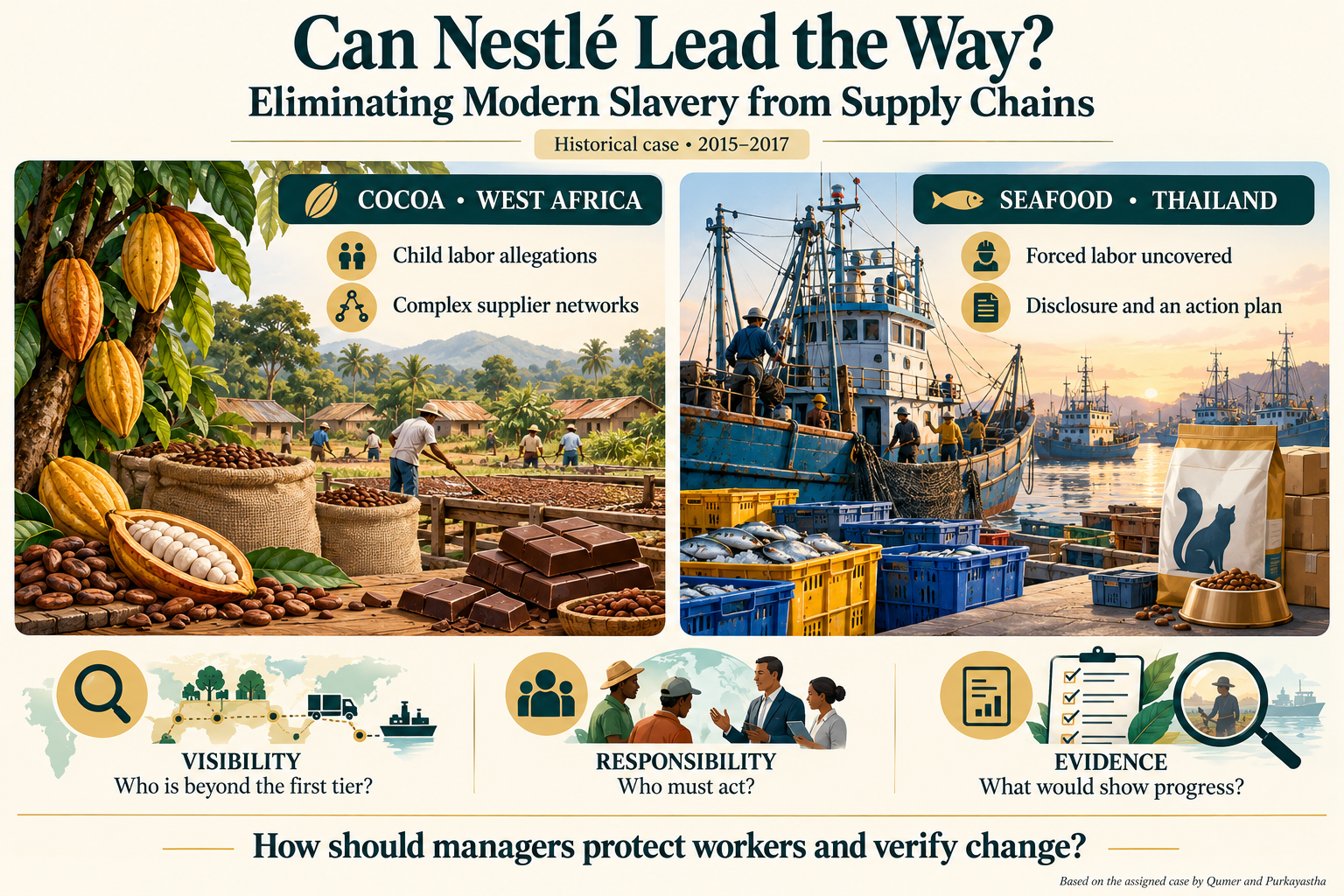
A familiar product can connect consumers to working conditions they never see. Set in 2015–2017, this case examines Nestlé’s response to child labor allegations in its West African cocoa supply chain and the forced labor uncovered in its Thai seafood supply chain. Disclosure brought both praise and criticism, raising questions about the company’s responsibility and the credibility of its response.
As you read, put yourself in the position of a manager deciding what to do next. Suppliers, intermediaries, poverty, and limited visibility complicate intervention. Consider which actions could protect workers, what unintended consequences might follow, and what evidence would demonstrate lasting improvement.
Read the assigned case in your course text.
A visual starting point for the discussion. Use the case evidence to develop and support your own recommendation.
Keep this question in view: What should Nestlé do next, and how would you know whether its actions were making workers safer?
Case Overview Video
Case authors: Syeda Maseeha Qumer and Debapratim Purkayastha, IBS Hyderabad. This introduction and infographic summarize the assigned historical case; they do not present a current assessment of Nestlé.
Session 1 / Guided practice
Learning to analyze a case
This first case is an ungraded learning exercise. There is no written submission for this case. We will use it to practice how to move from identifying a management problem to explaining a decision. The examples below illustrate how that thinking could appear in a later written case analysis.
A useful case analysis has three connected parts: identify the central issue, examine the company’s response, and evaluate that response. Read the guidance first, consider your own interpretation, and then open each sample response.
Here is what I am looking for: Help me follow your thinking. Establish what happened, explain how the company responded, and then develop a supported judgment about how well its response addressed the issue. Use course concepts and specific case evidence. Distinguish commitments and activities from demonstrated results, acknowledge limitations in the evidence, and explain why your assessment is reasonable.
For future written case analyses: Sections 1 and 2 combined should not exceed one page. They provide the foundation for your evaluation. Section 3 is the most important section and should receive the greatest attention and development. For this first case, these expectations guide our discussion and examples; no written submission is required.
Section 1
1. Identify the Central Issue
What this section does: Establishes what happened and why it mattered. Focus on the central ethical or management issue rather than retelling the entire case.
What you could include: A brief account of the issue, the stakeholders affected, and a few facts that establish its significance. Distinguish allegations, documented findings, and your own interpretation.
A useful starting question: What happened, who was affected, and why did it matter?
Sample response · Identify the Central Issue
Nestlé faced a gap between its commitments against abusive labor practices and conditions within its supplier network. The case described child labor concerns in West African cocoa sourcing and Nestlé’s disclosure of forced labor in its Thai seafood supply chain (Qumer & Purkayastha, 2018, Sections 4 and 6). These issues affected vulnerable workers and families while raising questions about the company’s responsibility for suppliers beyond its direct operations. The central issue was whether Nestlé’s commitments were being translated into meaningful worker protection.
Notice the move: The response establishes the issue and its significance with selected evidence. It leaves space for the evaluation.
Section 2
2. Examine the Company’s Response
What this section does: Explains what the company actually did and connects those actions to relevant course concepts. Describe the response before judging its effectiveness.
What you could include: The principal actions, their intended purposes, and a connection to social responsibility, ethics, or interdependence. Select actions that will matter in your evaluation.
A useful starting question: How did the company respond, and what was it trying to accomplish?
Sample response · Examine the Company’s Response
Nestlé introduced community-based monitoring and remediation in its cocoa supply chain, including efforts involving schooling and family income activities. In seafood sourcing, its action plan included anonymous reporting, third-party vessel verification, and an emergency response team (Qumer & Purkayastha, 2018, Sections 5 and 6). These actions reflected social responsibility by addressing workers’ welfare and interdependence by involving suppliers and local partners. They were intended to improve detection and correction of abuse, although their existence alone did not establish their effectiveness.
Notice the move: The response explains the actions and their purposes. It connects them to course concepts without treating activity as proof of success.
Section 3
3. Evaluate the Response
What this section does: Develops your judgment about how effectively the company addressed the central issue. This is the most important section: explain why the evidence supports your assessment.
What you could include: Strengths and shortcomings, evidence of results, stakeholder effects, and limitations in what the case establishes. Distinguish promises, actions, and outcomes. Consider the company’s constraints without treating them as an excuse. Improvements may follow from your evaluation, but a separate recommendation section is not required.
A useful starting question: How well did the response address the issue, and what evidence supports your judgment?
Sample response · Evaluate the Response
Nestlé’s response represented meaningful progress, but the case did not establish that the company had adequately resolved the underlying labor abuses. Its strongest feature was the movement beyond a supplier code toward mechanisms that could identify and address harm. Community-based monitoring and support for education and family income recognized that child labor was connected to local living conditions, rather than simply to suppliers’ willingness to follow rules (Qumer & Purkayastha, 2018, Section 5). From a social responsibility perspective, this was a more substantial response than relying on public commitments alone.
The seafood response also offered evidence of improved visibility. The case reported that, by the end of 2016, more than 99% of seafood ingredients sourced through Nestlé’s Thai supply chain were traceable to vessels and farms (Qumer & Purkayastha, 2018, Section 6). This was an important operational achievement because it could help identify where intervention was needed. However, knowing an ingredient’s origin did not demonstrate that workers at that location were free from coercion. Traceability therefore supported accountability without proving that the central problem had been solved.
The cocoa response was less convincing in its coverage and verification. The case reported criticism that monitoring and reporting did not adequately represent the wider cocoa network. It also described the difficulty of reaching lower-tier suppliers and obtaining reliable information from workers who feared retaliation (Qumer & Purkayastha, 2018, Sections 7 and 8). These limitations weakened confidence that the reported initiatives protected workers consistently. The company’s interdependence with farming communities complicated withdrawal, but that difficulty did not make continued abuse acceptable.
Overall, I would assess the response as a necessary but incomplete effort. Nestlé had created mechanisms capable of supporting improvement, yet the evidence was stronger for the existence of programs and improved traceability than for sustained protection throughout the supplier network. A more favorable assessment would require independent follow-up showing that identified abuses were corrected, workers could report concerns safely, and protection extended beyond the locations already monitored. That distinction matters: a responsible response should be judged by its effects on workers as well as by the actions the company announced.
Notice the move: The response makes a clear judgment, weighs favorable and unfavorable evidence, and explains what the evidence can and cannot establish. The evaluation receives substantially more development than the first two sections.
Using case evidence
The examples paraphrase the assigned case and use APA author–date citations with section numbers as our classroom locator. Cite the case authors when reporting case evidence. Clearly identify your own interpretation or proposed action.
Example: (Qumer & Purkayastha, 2018, Section 8).
The supplied case has unnumbered headings. For this exercise, use the following reading-order key; these are classroom section numbers, not numbers printed in the text. The original ICMR case listing identifies 2018 as the publication year (case code BECG159).
Section
Heading in the supplied case
1
Opening case narrative (before Background Note)
2
Background Note
3
Modern Slavery in Global Supply Chains
4
Child Slavery in Nestlé’s Cocoa Supply Chain
5
Nestlé’s Initiatives to Address the Issue
6
Nestlé Admits to Forced Labor
7
Criticism
8
The Way Forward
Qumer, S. M., & Purkayastha, D. (2018). Eliminating modern slavery from supply chains: Can Nestlé lead the way? [Case study, BECG159]. ICMR. Original case listing.
Session 2 / Student-led learning
Your turn to lead
Create a short learning session that helps classmates apply an idea from our work on social responsibility, ethics, and interdependence. Your task is to make a focused topic understandable, show why it matters to international managers, and give the class something worthwhile to think about.
Time limit: no more than 10 minutes total. Include any video, activity, and class discussion within that limit. Choose a scope you can teach clearly in the time available.
Choose your delivery mode
You may use PowerPoint, an infographic, or video. Other suitable approaches include a short live demonstration, a role-play, a guided discussion built around a visual, or an interactive poll or mini-scenario. You may combine formats when doing so supports the learning. Whatever format you choose, use it to guide a coherent session and make your explanation and analysis clear.
Five possible topics
Transparency: what should a company disclose? Explore the value and risks of revealing a supply-chain problem. Use an example to distinguish honest disclosure from evidence that the problem has been addressed.
Supplier misconduct: stay and improve, or walk away? Examine how a company might respond to an abusive supplier and how each response could affect workers, families, and the business.
Who is responsible beyond the first supplier? Explain how a product can pass through several organizations and consider how far a multinational company’s responsibility should extend.
Responsible action or reputation management? Use a company initiative to explore what evidence would help distinguish a substantive response from a primarily promotional one.
When global standards meet local conditions Explore how a manager can uphold worker protections while responding to pressures such as poverty, limited schooling, or dependence on supplier income.
Original topics are welcome, but you must obtain my approval before you begin compiling materials for your session. Propose a focused topic and briefly explain its connection to international management.
Give your session a clear shape
Open with a question, example, or dilemma that establishes the focus. Explain the relevant concept in your own words, then use a concrete example to help classmates apply it. Invite a brief response or decision from the class, and close by drawing the learning together into a clear takeaway. This is a flexible sequence; adapt it to your topic and delivery mode.
General guidance for success
Teach one meaningful idea well. A narrow question explored thoughtfully will help the class more than a broad collection of facts. Make the connection to international management explicit.
Explain the significance. Move beyond reporting what a company did. Help classmates understand why the example matters, who is affected, and what it reveals about responsible management.
Use evidence thoughtfully. Support factual claims with credible sources and identify them in your slides, infographic, video credits, or accompanying materials. Distinguish a company’s claims from independently supported results and your own interpretation. Use APA author–date citations where appropriate and provide enough source information for classmates to locate the material.
Design for your classmates. Keep text readable, visuals purposeful, and audio understandable. Caption video where possible. Explain unfamiliar terms and give the class enough context to participate.
Make participation purposeful. Ask a focused question or offer a short choice that helps classmates use the idea. Leave room to respond to what they say and connect their contributions to your takeaway.
Rehearse the whole session. Check the timing, media, and transitions. Have a simple backup if a link or video fails. Finish within 10 minutes with a clear statement of what classmates should carry forward.
What I am looking for: A prepared, understandable session that helps your classmates learn and apply something useful. Let your topic, evidence, and explanation guide your choices. The format should support the learning.